Lend a hand to the #KnitPetiteProject and answer this brief survey!
We’re wrapping up March and the first section of the #KnitPetiteProject with a comparison of some sizing charts. Now that we’ve looked in depth at the history of sizing and why we may encounter petite fit issues, we can take those numbers from our measurements taken in February and have a practical look at a few examples of sizing charts.
Let’s look at how to look at charts.
Decoding the Chart
You’ll find sizing charts in many places: the back of a changing room door, in an online retailer’s pop up window, maybe even on the clothing tag itself. Sadly, though, the information included on those tags and in those charts isn’t always super thorough. You may only get one or two measurements listed; you may have no idea what cross-back numbers they’re working from, or what the shape of their fit model may be.
But sometimes you can find more detailed information.
The rise of online shopping has motivated retailers to include more info for consumers; retailers don’t want you to return their product! So, they prep you with more detailed sizing charts than you might otherwise have encountered in a brick-and-mortar store.
One of the key questions to ask when you’re faced with these sizing charts is “what do these numbers mean?”
#1. Make sure you know that these numbers are either body measurements OR garment measurements
This makes quite a difference. The chart below from CYC (which many knitwear designers and publications1 rely on for their sizing) gives body measurement numbers.
You can tell this because when you visit the CYC website here, they actually have written in all caps, “THESE ARE ACTUAL BODY MEASUREMENTS FOR BABIES, CHILDREN, WOMEN, and MEN in both inches and centimeters.”
The body measurements vs garment measurements is very easy to mix up!
And if you’re interested, the CYC has also listed on this page a wee chart that has general guidelines about our NEXT important chart-decoding point.
#2. EASE
The CYC chart illustrated above is ACTUAL body measurements, but unless you’re a designer, you’ll likely encounter measurements listed on a pattern that are the garment’s finished measurements.
The reason there’s a difference is EASE.
Ease is the amount of extra (or less!) space designed into a garment for considerations such as the wearer’s comfort, style, function of the garment, etc. For example, a sock generally has to be snug to stay up on your leg, so because of this function, it’s usually a bit smaller than your actual foot measurements. This is negative ease.
Sometime style may dictate that a sweater be oversized. This means that the numbers listed for the finished sweater should be larger than your actual body measurements. This is positive ease.
For some visual examples of ease, you can read over my detailed post from 2012 here, that uses a single sweater design in a variety of eases on a variety of people.
Designers generally include notes about how much ease is designed into the sweater, and more recently, patterns have also begun to note the size of the photographed model vs the size of the sweater she’s modelling. This is extremely valuable information for YOU as the knitter to make a choice about how you want your garment to fit your body.
We’ll be having a more nuanced conversation about ease in the next 3 months; it’s a topic that a number of you pointed out as important in the first #KnitPetiteProject survey, and it’s a rich and significant topic when it comes to making informed decisions about how you want your clothes to fit YOU!
#3. Who is this Chart For?
Sizing charts, whether large or small, have any number of different intended audiences. Like we mentioned above, sometimes in-store retailers give consumers only a small amount of information on the tag, presuming you can easily go in to the change room and try it on.
Sometimes the information included is intended for designers; this usually means there’s a lot more info on the chart.
And sometimes you can find charts that have a more specific target than just “adult women”. Sometimes you can find detailed charts with information especially for petite women, plus-size women, tall women, older women, etc…
Examining Charts
For each of the charts we’ll look at below, have your numbers ready and ask yourself these questions:
Who do I think this chart is for/who does it represent?
What are the differences in my numbers and the chart numbers?
Knitwear Designer Charts
Now that you know the CYC chart above is actual body measurements, let’s take a look at what it tells us. The good thing about CYC is that it includes nine different points of measurement, and has a large size range for adult women. Significantly, it has some key length numbers such as armhole depth and back-waist length.
And of note, this chart is intended for knitwear designers, and is a popular source of information. If you encounter consistent fit issues in your knitted sweaters, it may be worthwhile taking note of the differences between your numbers and CYC’s numbers. We’ll be going in to more detail about this over the next 3 months.
Ysolda’s New Chart: As you probably already know, I’m pretty excited about Ysolda’s new chart.2 This is another sizing chart used by many knitwear designers, so looking at this and becoming familiar with its content is knowledge you can apply when you are selecting and/or modifying your next knitting pattern.
Take out your numbers again and have a peek at Ysolda’s charts. Any differences? How does it measure up against CYC for you?
Ysolda takes sizing very seriously, and has included some important background information on how she created these charts. She says “[e]ssentially this is a compilation of sizing charts from a range of sources, including the ASTM standard charts for misses and plus-size women and several patternmaking manuals. It’s specifically intended for grading hand knitting patterns rather than sewn garments and follows knitting industry conventions …” (emphasis my own). She also makes it very clear that these are body measurements. Now, we know that Ysolda looked at some of the charts and background info we’ve looked at, including ASTM.
Ysolda goes on to talk a bit about CYC; “Many publications require designers to follow the sizing charts published by the Craft Yarn Council. These lack measurements and, I suspect, cause some confusion around shoulder widths and armhole depth. I’ve tried to make a chart that follows the sizes set up in that chart but with a wider range of measurements.” (emphasis my own)
Significant! Because Ysolda’s let us in on her thought process and research, we can see the differences and some motivation behind her charts, and perhaps find that those differences are significant enough for us to prefer one chart over the other.
And, if you read nothing else about Ysolda’s charts, I hope you check out what she has to say about LENGTHS:
“You’ll notice that some lengths are consistent across the size range. This is because the sizing chart is based on women of the same average height across the size range. Whether larger bust sizes should also be proportionally taller is a matter of some debate, and you may wish to make slight adjustments to these measurements.
The length of the underarm to neck area *will* increase between sizes, some designers handle this by reducing the sleeve and body lengths as the sizes increase.
Personally I prefer to keep sleeve and body lengths close to the same across the size range allowing knitters to make adjustments as required for height independent of bust size. The exception is for very close fitting garments where a little extra length is required to follow the curves of the body in larger sizes.”
So folks, as you see, while two of the most popular knitwear sizing charts don’t specifically include petite measurements Ysolda has at least addressed lengths, with guiding thoughts for the designer (and all of us, as knitters!)
One of the questions that came up in the first #KnitPetiteProject survey was:
Why do the designers think that if my bust is larger, my arms and shoulders have also grown immensely?
You can find at least part of the answer in Ysolda’s discussion on lengths.
Sewing Charts
Let’s take a wee peek at some charts from history: vintage sewing charts that are based on those PS42-70 (PDF) standards we looked at a few weeks ago.
Those standards were readily embraced and applied by home sewing companies, but many large retailers eschewed them. And as we mentioned earlier this month, sewing companies themselves aren’t using all these charts any longer. You can’t find just petite sewing patterns from the big companies.
But hey, let’s take a look anyhow and see what we’d have been faced with in the 1970s.
The lovely retro sewing book I’ve taken these charts from is The Reader’s Digest Complete Guide to Sewing from 1978.
Here you can see how, back in the 70s, sewing patterns were broken down into a greater variety of body types, including height and weight differences. As we’ve seen, ultimately these numbers are flawed and represent an out-dated, limited set of individuals.
Knowing this history is valuable for moving forward!
And, for some more recent sewing charts, below you can see Simplicity’s chart, (one of the Big Four sewing companies). This is taken from their free Sewing Pattern Fit Guide PDF
And why is this chart the way it is?
Last year, Seamwork Magazine published a fantastic article about the history of clothing sizes. In it, the author interviewed the Design Development Director for Simplicity, Deborah Kreiling. She said, “Our patterns size standard measurements have been the same since the mid-1960s…In the mid-1980s the four big brands regrouped and felt that there was no need to reinvent pattern sizing. As long as we were still using the same standard body measurements to create the patterns, the sewing customer, at least, had something that remained true.”
So THESE numbers are the same, but why is it so difficult to find all those varied Junior, Junior Petite, Petite, etc sizes?
In their chapter on Sizing for the Home Sewing Industry, S. P. Ashdown, L. M. Lyman-Clarke, P. Palmer note that “…many of the categories that were experimented with in the past did not sell well enough to produce and have been eliminated. One such category is a miss petite size defined as approximately 5 feet 2 inches, and average bust, short in the torso (short waisted) and slightly larger than misses’ sizes in the waist.”3
And, just one more!
I haven’t found it easy to locate any good information out there about petite plus sizing. Pretty much the only source I did find was from Kathleen Cheetham of Petite Plus Patterns. Her patterns are designed, “…especially for the woman with narrow shoulders, D cup bra, rounded tummy…”.
Cheetham has stated outright the specialized group her charts are for. Do you fall into this group? Do you find these body measurements are closer to your own than some of the other charts we’ve seen so far?
They’re working to convince you that they’ve taken petite proportions and numbers into account in their clothing. I personally have never bought Old Navy petite clothes, so can’t comment on how accurate a fit they may give. But below, YOU can see the charts Old Navy uses. Note, these appear to be charts with only limited info, and appear to be just for lower body measurements:
Another retailer we can take a peek at is Reitman’s. They have sections in their online shop for petites, and even “ultra petites”, but I’m sorry to say that their sizing charts are an example of some of the LEAST amount of information you as a consumer can get. See them for yourself here: petite and ultra petite. Disappointing, yes?!
This is particularly annoying, as I found a chart (likely old!) that included a petite plus section for Reitman’s – a size chart that’s not easy to find!
#KnitPetiteProject Wants to Know…
In May, we’re going to start looking at the nitty-gritty of different petite mods for knitwear. The first post of the month is going to give some real-life examples of knits that have been modified for petite bodies.
Want to help out? Please let me know your experience with making petite mods to your knits. What modification did you make? Which pattern did you choose? Are you happy with the results? Contact me by replying to this post, or email me at canaryknitsdesigns at gmail dot com.
Thanks for your help!
The Second #KnitPetiteProject Survey!
In February and March we’ve laid a foundation for WHY we may encounter petite fit issues. Stay tuned in April, when we’ll be looking in depth at what those petite fit issues are. I’ll be asking for YOUR HELP, and sharing the results of the survey at the end of the month.
1Knitty is an example of a popular published that uses the CYC standards.
2 Ysolda’s old chart isn’t super easy to find online anymore, and I’m sure that’s intentional. She withdrew that chart a few years ago. If you’re curious about how her new chart differs from the old one, you can do a bit of internet searching and check it out.
When I started the #KnitPetiteProject I was convinced that there should be a sizing standard adhered to across the board: from the perspective of a consumer, I thought this would make it so much easier for me to select items store-to-store, and at the very least I would know that all items would need alterations in all the same ways.
The more I read, the more I have become convinced that this is a very difficult, maybe impossible and undesirable goal.
“Adopting a worldwide clothing sizing standard, especially for body size dimensions, is difficult if not impossible, given the wide variation in body dimensions and cultural diversity in shopping and product expectation.”1emphasis my own
Sizing Standards are Voluntary
As we’ve seen over the past few weeks, the creation of sizing standards is a large, research-intense undertaking by governments or international standards bodies, whose findings are voluntary for manufacturers and retailers.
As a refresher, some standards-creating bodies currently are ISO and ASTM.
Smaller Population Target = Higher Accuracy of Fit
A research guide from Tufts notes a few important guidelines when it comes to working with anthropometric data:
Most data sets focus on particular populations, such as children, populations sharing a particular medical condition, or members of a profession, such as the military or an athletic sport. These should not necessarily be extrapolated to general populations.
Apples must be compared with apples, not oranges. When merging multiple data sets, make sure that they share common features such as units of measurements, the physical condition or age of the subjects measured, etc. Pay attention to the terminology for specific measurements.
Chronology and geography is important. Averages evolve over time due to migration, changes in diet, mortality, and other factors. Data collected in a one country or region 50 years ago may not apply to a later population in a different location.
Even if a widespread, representative body scan project was implemented in the United States today, all the data collected would have to be revisited in a few years to ensure accuracy. It would also have to be narrowed into representative groups of individuals (in this case outlined as children, those with certain medical conditions, etc). Of course, this applies to the segment of adult females as well.
A researcher we’ve referenced earlier, K.L. Labat, states that “[t]he need for an international standards organization is not in developing a worldwide standard with a one-size-fits-all agenda, but to coordinate and make available body measurement data from all the countries wanting to participate in world trade of apparel.”2
Also noted from Labat is the desirability of defining sizing systems for specific target markets, gaining a better understanding of the differences and similarities of human bodies. I’d like to think we’re working toward that with the #KnitPetiteProject!
Variations between Nations + Ethnicities
To flesh out the idea of smaller target population, take a look at this info: Labat outlines a number of different countries and their work toward developing a sizing system. Check out the info below and how much it varies:
Germany (1983) published a system that identified 9 figure types using the height by hip as the key dimension.
Hungary (1986) created its system using height and body build with 3 key body measurements.
Korea (1990) used 5 height groups for its system.
Even within the same nation, there may be a variety of body type differences associated with ethnic backgrounds. The data we looked at last week from the CDC (pdf) gave us a bit of insight. This article from scholars C. L. Istook and S-J Hwang Shin argues the importance of understanding the shape of diverse ethnicities: “This study revealed that ethnic groups had different fit problems and significant body shape differences. Even within the same figure type category, a variety of body dimensions existed in each ethnic group.”
Size as Marketing
“…is it possible to satisfy all of the female population with a manageable number of standard sizes? Based on the conservative estimates expressed in our question above, a retail store would have to carry some 72 different sizes to cover the entire female population!” 3 emphasis my own
Susan Koger, co-founder and chief creative officer of ModCloth, wrote this op-ed for the Business of Fashion in April 2015. Through customer feedback and independent 3rd party surveys, ModCloth discovered that 88% of women size 16+ would buy more clothes if they came in larger sizes. There was considerable work involved in order to serve this segment of ModCloth’s market: as Koger says, “…we set up a dedicated team to ensure fit and proportion are properly executed across all sizes, and shared this with designers that sell on ModCloth, as many lacked the resources to extend their sizing.” Ultimately, this was a very successful and valuable decision for the company.
Personally, I know I have made purchases through this website because of its brand-attitude toward body positivity – they appear to very much believe in this ethos, not only creating / supporting / selling clothing in larger sizes, but also including (un-photoshopped) images of larger sized models.
Size as marketing is powerful: this ModCloth example demonstrates how a company looked into their market, did their research, worked through all the follow-up steps, and delivered on their value statement, becoming attractive to customers because of this work, as well as the pure existence of the clothing sizes they sell.
If ModCloth had to stick to an (inter)nationally dictated sizing system, this work may not have been accomplished. The company was able to look internally and serve its market.
Companies and manufacturers with up-to-date anthropometric data can select out the numbers for their own target market and serve those individuals with a greater accuracy than, say, a company that relies on charts/data that represent an average woman from the total female population. Or, even more skewed, a set of data from a female population entirely apart from the one they wish to serve.
The lack of an enforced (inter)national sizing standard means that as consumers we may lose the ability to hop from shop to shop, knowing we’re always a size 12. But it also means that we may be able to find a shop for whom WE are the target, and have an even better fit experience, consistently, within that manufacturer.
Fun Fact
Perhaps this fact isn’t “fun” so much as interesting: according to the Youtube stylist Lauren Messiah, within the fashion industry “tolerance” allows the garment creator a margin of human error: it means they can mess up within 2 inches ie: cutting too much fabric from the pattern, machine skewing and messing up seam allowance, etc… You can pick up the same shirt/brand/style/size within the same store and they may not be the same at all!
“The number on the tag doesn’t determine your worth, and it’s not even true most of the time.”
Question
Have you ever purchased clothing (IRL or online) from a foreign country? Did you notice any differences in the sizing?
#KnitPetiteProject Wants to Know…
In May, we’re going to start looking at the nitty-gritty of different petite mods for knitwear. The first post of the month is going to give some real-life examples of knits that have been modified for petite bodies.
Want to help out? Please let me know your experience with making petite mods to your knits. What modification did you make? Which pattern did you choose? Are you happy with the results? Contact me by replying to this post, or email me at canaryknitsdesigns at gmail dot com.
CDC Vital and Health Statistics, Anthropometric Reference Data for Children and Adults: United States, 2007–2010, October 2012. Accessed March 13, 2017. PDF
In anticipation of the standardized chart comparing we’ll be doing at the end of the month, this post will look at some of the differences that exist in the ASTM size charts for Misses and Misses Petite.
ASTM: Comparing Misses’, Misses Petite, and Women’s Plus
The ASTM sizing standards are a good place to start when comparing sizing differences: while they are indeed voluntary for the apparel industry, they are influential, regularly updated, created through various expertise sub-committees, and relatively inexpensive for individuals to obtain (charts cost around $45). I know these charts are used by some designers within the knitwear industry; Ysolda’s newly updated chart cites ASTM data as one of several sources.
As the full charts are behind a paywall, I’m only sharing the above information from Wikipedia and a few comparison points below. This will give you a general idea of the area of difference within ASTM as an influential organization’s suggested standard.
To clarify: as I know I certainly get these numerically-referred to charts confused: the Misses’ Chart is ASTM D5585, the Misses’ Petite is ASTM D7878, and the Misses’ Plus is ASTM D6960. I must apologize, as I don’t currently have a copy of the Women’s 55 years and older chart ASTM D5586; I hope to get that one soon and be able to include it in comparison in the future.
A few things to note about this chart:
ASTM develops these tables from a variety of data sources including: the U.S. Department of Commerce, the Caesar study, SizeUSA, current U.S. industry standards, and studies, scans and documentation from Alvanon Inc. They have also included variations in size for curvy and straight body shapes, as you see above.
These charts leave out an upper size range in the petites, cutting them off at a 46″ bust. They also increase the backwaist length through all three charts (even though they take as standard a particular total height). The backwaist length at its shortest in petite is 15″ 3/8; the same bust size in regular misses is 16″ 1/8 and the smallest plus size has a backwaist length of 16″ 1/2.
An important take away: check the garment schematics for your knitting patterns. Good patterns will have good schematics with many different measurements included. Something important to look for is that total body length / sleeve depth / bottom of sleeve to bottom hem.
It’s also important to note that these charts we’re looking at today are body measurement charts, and that knitting schematics are (supposed to be) measurements of the finished knit, NOT the body. Designers have taken into account ease of various kinds and amounts depending on the style and body part being covered. Confusing, I know! But if you peek forward in the #KnitPetiteProject Plan, you’ll see I’m hoping we can have a KAL later this year where we can all work together and help each other understand our own petite needs.
The petite group showed significantly lower mean values than the regular group for all the vertical measurements. The petite group had a 3.7″ shorter stature, 2.16″ lower crotch height, and 1.26″ lower knee height on average than the regular size group…. The petite group also had significantly shorter lengths than the regular group by 0.14″ at shoulder length, 0.82″ at the back waist, and 1.52″ shorter for arm length. pg 55
Interestingly, this study also found significant differences in the SizeUSA data between the widths of regular and petite women. We might guess this is obvious if we think about the way we culturally use the word petite. But something that may NOT be obvious is the numbers show that petite women had a smaller drop value between waist and hip than the regular group (that is, the difference between waist to hip, or bust to waist).
As a reminder, this is the study we looked at that outlined different ways you can be petite, from top petite, bottom petite, average petite, and plus petite. It might make more sense now that I remind you the ASTM charts, according to this study, most closely matches the measurements for top petite.
You Should Read This
As the #KnitPetiteProject progresses, I keep reading! I’ve already come across (new to me) sources filled with info that anyone can access, and are topics that have already been addressed in previous weeks’ posts.
I figured, instead of going back and editing those old posts, I’d start a new section wherein I’ll alert everyone to some cool reading material you can easily access and learn from.
This week is the first!
As mentioned a couple of weeks back, there is nearly no research done and applied from petite anthropometry data, and that data is what is needed to form an accurate and appropriate sizing standard. Some of the papers that do exist on the topic are from graduate level students. One such is an exploratory study by Lisa Barona McRoberts for the Louisiana State University titled “Petite Women: Fit and Body Shape Analysis“. In her opening abstract, she states that”[f]igure type analysis of the sample indicated that most subjects were outside the industry silhouette definitions. None had the industry standard hourglass figure.” (pg vii). I’d recommend you read over her paper: it’s written in a very accessible way, and is filled with great information like a review of the literature to date.
Fun Facts from her paper
47% of the women in the United States between the ages of 20 – 49 are petite.
SizeUSA was created by TC2 primarily to create a new sizing standard for ASTM and private clients (thus restricting the disclosure of the data and results, ie: I can’t share all the data with you!)
“Despite the large percentage of petite women between the ages of 20 – 49 in the US, the sector has been largely overlooked. With the Latino and Asian population increasing throughout the country smaller sizes are needed”. (pg 17)
As a side note: SUPER interesting data from the CDC (PDF): they have charts filled with anthropometric data that show percentiles for all measurements and separates out data from individuals from different races. They oversampled individuals “60 and over, all Hispanics persons, black persons, and those with low income to improve the precision of the statistical estimates for these groups.” (pg 1)
According to the Standardized Pattern Measurement Chart for Women by Brackelsberg and Marshall from 1994, Misses’ petite sizes are 3/4 – 1 inch shorter between the back neck and waistline and 1/2 – 1 inch shorter between the waistline and the hipline than the measurements provided by the misses’ patterns. (pg 25)
The study conducted for McRoberts’ paper consisted of 52 petite women, 5’4″ and under, ages 20 – 49, taken from a metropolitan centre in the southeastern USA. They took a variety of measurements.
The above chart is simply the data from that PS 42-70 standardization chart we talked about last week. The chart below is a comparison of the data from McRoberts’ study and the petite data from PS 42-70:
Check that out: they found that the voluntary product standard and sample mean numbers showed significant differences in back neck to waist length. And, as McRoberts states, the back waist measurement is one of the most important measurements!
Fun Fact
Why is it so hard to find petite sizing in modern sewing patterns? According to S. P. Ashdown et al in their paper “Sizing for the home sewing industry”, comparing a misses regular size 14 and misses petite size 14 shows relatively minor measurement differences, so pattern making companies generally do not make petite patterns today. Note: this is information from sewing charts, which is taken from all that old data! Let’s hope computer assisted design and body scan technology help to update this, so the idea of petite bodies can have a greater place in our craft industry!
Question
Do you sew? Did you notice the lack of petite-specific designs today? Do you think separate, petite sizing should be reinstated based on new data?
CDC Vital and Health Statistics, Anthropometric Reference Data for Children and Adults: United States, 2007–2010, October 2012. Accessed March 13, 2017. PDF
TC2, World Leading 3D Body Measurement and 3D Visualization. Accessed March 13, 2017.
While reading more and more about the history of sizing standards I’ve personally noticed a couple things happening to my attitude towards clothing and sizing standards:
These standards are not something stemming from time immemorial. They have a relatively short history, which makes dismantling them a more approachable undertaking.
My sympathy towards clothing manufacturers has grown. Trying to serve populations with clothing that delivers a satisfying fit is tremendously complicated.
I’m sharing this information with you today, so that you too will feel even more prepared to dismantle (figuratively and literally!) clothing and sizing standards to suit your own tastes.
Since the time of the industrial revolution and the first widespread introduction of mass-produced clothing the apparel industry has struggled with the inherent contradictions of providing well-fitted clothing within the constraints of economical and practical sizing systems for the variety of people in a population. People vary along many dimensions, resulting in a multitude of sizes, proportions and postures to be accommodated…The complexity of sizing for clothing is unmatched by any other consumer product.1(emphasis my own)
How Standardized Sizing Began: the 1800s
The interest in stable units of measurement stretches back to the Middle Ages. If you’re as nerdy about this as I am, you can find all sorts of interesting info about the vast array of length measurements dotting maps from the Age of Exploration onward for centuries.
That said, in order to produce a system of standards for clothing you need more than just stable units of measurement.2
Prior to the 1800s there isn’t much evidence of systematized measurements being applied to drafted patterns. This changed through several forces near the beginning of that century including industrialization and war. In particular, the Napoleonic Wars brought great need for clothing en masse, and demonstrated that the grading that existed was insufficient. Crude and simple tactics to create grades can be seen in the 1820s; European tailors appear to have been the first to base their measurements on anatomical information and relate that to proportion and pattern drafting.
As far back as 1826 there is evidence from the French tailor Michel Bailley that the breast measurement was the most significant number upon which many proportional drafts were based.
In the 1840s, mathematical interest in averages were applied to clothing through the work of the Aldolphe Quetelet.3 He took tools used in astronomy and applied them to people, first using data from soldiers to determine their “true” chest size. By the end of the 1800s, dressmakers’ manuals included tables of standard measurements that were proportional, and examples in sizes that (much like today!) were based on the bust size.
The fashion of the mid-late 1800s played a role in the need and desire for more exact sizing standards. Womenswear was quite close fitting and based on the changing shapes of corsetry. Dressmakers needed a system that was simpler and more efficient than the complex system that existed in order to produce clothing for their customers.
Charles Hecklinger in 1891 created the first systematic method of block adaption for women’s clothing. Looking at charts like this shows us the mathematical attempts at sizing simplification and standardization, and particularly show us the idea that circumference was thought to be tied to vertical measurements.
By the end of the 1800s, the mass production of women’s clothing in America was greater than the output from dressmakers. This is important to note because it was in America that the first major standardization studies were created only a few decades later.
In Europe this process developed more slowly, with small workshops and independent dressmakers using tailors’ techniques, giving them the ability to deliver personal service and close-fitting, fashionable garments.
The 20th Century
The fashions of the early 20th century played a part in the standardization of sizing. The old, distorted shapes created through corsetry were discarded, and a move toward looser, more flowing lines was embraced. This meant you were less likely to need such precise fitting for those “flapper” fashions; the attitude toward buying mass-produced clothing changed as well.
Those averages we referred to earlier from Adolphe Quetelet were again utilized for WWI; in WWII, however, it was discovered that those averages actually ended up serving no one perfectly rather than everyone sufficiently, and as we see today, the ideas of customization/adjustment were built into things like pilot’s seats in planes.
It was in this zeitgeist that the first large-scale collection of anthropometric measurements from women was undertaken from 1939-1941 by R. O’Brien and W.C. Shelton, supervised by the United States Bureau of Home Economics. This study is immensely important because it became the model upon which measurement data was collected throughout the world, and these numbers have greatly influenced sizing standards to this day. We should note that this was undertaken by the government, and that the adoption of its findings were voluntary.
While in theory we might think this study is a great basis of information for the clothing industry, there’s a few factors we should take into account.
Many clothing manufacturers and retailers aren’t keen on utilizing information of this sort. The data collected in the O’Brien + Shelton survey was limited to 10,042 women, all of whom were white Americans, aged 18 – 30 years old.4Restricting the data collected to this population results in a misrepresentation of information; the importance of attention paid to a variety of body shapes associated with different ethnicities is erased. This data was intended to be a recommendation for the representation of all American women, and ended up representing a very narrow field of them.
The era of the survey also reflects a skewing of data; you can see this skew through the desire to update O’Brien + Shelton’s work in the publication of Voluntary Product Standard PS 42-70 (pdf here). One of the reasons there was a revisit of this data was a push from the Mail Order Association of America. After the association implemented the 1958 standard created from O’Brien + Shelton’s data, it found that this standard did nothing to reduce returns from customers due to poor fit.
The MOAA saw the then 20 year old information as unrepresentative of contemporary female body proportions. By the 1960s, data from health surveys showed that women were taller and heavier than they were in the time of Shelton + O’Brien; that said, the PS 42-70 revision was more a shift in size designation rather than a full undertaking of new data collection.5 Which of course means that changes were limited and accuracy was not particularly increased.
ASTM
Throughout the second half of the 20th century there was much work done in countries around the world to develop standards, all voluntary, and many undertaken by non-governing bodies.
ASTM International (American Society for Testing and Materials) was formed in 1898 and is one of the largest voluntary standards development systems in the world.6 ASTM is the group that administers the standard today, and it’s believed to be the basis for womenswear made by US companies today.
It’s “believed to be” because clothing manufacturers and retailers have their own, defined target markets, and want to serve those markets by developing sizing standards which create consistency within their store to build trust and brand loyalty. This is why you may enjoy the fit of a size X in one store, but find that the same size X in another store doesn’t fit at all. Companies develop their own standards through their choice of professional fit models who reflect the target market, related banks of information (eg: automotive industry), sizing charts from competitors, and their own data collection surveys.7 These differing standards can be understood fundamentally as a marketing tool.
Attempting to serve all American (Canadian, UK, Australian, etc…) women is a nearly impossible task – just imagine all the different factors of human body shape that would have to be taken into account for such a system to function. Dividing the population into smaller groups based on differing factors helps make this task more manageable. For example, ASTM administers a Standard Table of Body Measurements for women who are 55+ years old. This standard, ASTM D5586, shows differences in measurement from the PS 42-70 data, many of which were related to posture, body carriage, height, weight, and change in the shape of flesh and muscle as women age.8
This 2016 article (PDF) from the Journal of Textile and Apparel Technology and Management shows the continued importance of ASTM’s standards by using it as a comparison point against which data from SizeUSA is measured. The study compares regular sizes rather than petites, but is valuable to us in highlighting how the prevailing sizing system, even for regular sizes, is not reflective of the measurements of the population.
Developing a New Standard
ASTM developed the data for D5585 in 2011 not through a new anthropometric study, but instead by comparing apparel company and military anthropometric information. This feels frustrating to those of us on the receiving end of the information, though it’s important to note the difficulties in undertaking a brand new data collection survey. It’s expensive; it requires trained individuals to do the measuring (and/or expensive 3D body scan technology); the survey itself must be carefully designed to reflect a variety of peoples and shapes across ethnicity/geography/age and other factors; volunteers must be gathered; and a method must be developed to analyze the collected data.
When looking at the data to create standards, you can group the information based on the average (giving a reasonable fit for the majority near the middle of the distribution, eg: one size fits all garments like t-shirts, socks, tights), a range (which accommodates a larger percentage of the population which is where most ready-to-wear sizes are developed), or extremes (where very small or large sizes would be served, eg: petites, plus, etc).9
A particular population and their key dimensions have to be chosen to give structure to a sizing system, and then used to help predict other measurements, create size intervals, and distinguish body shapes. One hope for the future is the new technology of 3D body scanning.
Body Scanning Technology
This new technology is very exciting for academics in the field of apparel study. It can serve many functions, including offering new ways of analyzing body shapes, solving problems in sizing of apparel, evaluating the fit of garments, and eliminating the need for size charts and grade rules.10 On this website from Cornell University, you can see a comparison between a traditional fit-model based system of sized garments and the possibilities opened by body scanning for mass customization.
Countries that have undertaken studies using 3D scanning technology include Japan, the Netherlands, UK, USA, China, South Africa, Mexico and France.11
“Why do the designers think that if my bust is larger, my arms and shoulders have also grown immensely?”
This is a question asked in the first #KnitPetiteProject survey, and one that is perfect to address right here.
As you can see in the text above, systems of sizing standards have to take something as a key defining measurements. For Shelton + O’Brien in the 1930s, their recommendations were based on a correlation between weight, height, bust, waist, and hips. Because their findings were applied and mildly altered throughout the rest of the 20th century, they were wide-ranging and influential. That standardization requested by the MOAA in the 1950s (CS215-58) created a cascade of other countries developing such systems for themselves; a great example is the report published in Canada, using exactly the data from the United States.12
Anthropometric studies generally show that horizontal body measurements (girths) correlate well to each other, that vertical measurements (lengths) correlate well to each other, but that horizontal and vertical measurements do not correlate well.13
The ideas of correlation between those numbers of bust and shoulders traces back to that original Shelton + O’Brien (flawed, limited) data; of course, depending on where you got the garment, it may be a combination of that manufacturer’s own collected data, fit model, and target market.
Also of note is the petite fit paper we discussed last week, and that it states no study has analyzed petite size women’s body proportions and figure types using the recent and larger amount of anthropometric data currently available.14 Since we’re relying on that old data (unless/until 3D scanning technology builds a thorough database and academics sort through, make recommendations, and retailers apply that data), we’re all stuck in a place where the existing system, flawed as it is, presents itself as the overarching source of information.
As far as knitwear design goes, designers have to rely on some sort of standards to create their size ranges. As I alluded to in last week’s post, many knitting publications ask you to use the CYC standards, which include a relatively wide range of information, though it is limited in height data and has been found by some to be lacking in accuracy, particularly in the larger sizes.
A great example of how a variety of sources can combine in the creation of a sizing table is Ysolda’s new chart. For this new chart she lists the ASTM charts for misses and plus, as well as information from patternmaking manuals. She also notes, importantly, that these are body measurements intended specifically for knitwear (rather than, say, sewing). Ysolda’s chart is another popular option for sizing charts among knitwear designers, though, like the CYC, doesn’t separate out information for petite measurements.
All of this is to say that it’s very likely (especially if you’re in North America) that the clothing you’re wearing or designs you’ve made can trace their sizing back to that O’Brien + Shelton data, the CS215-58 standard, the PS 42-70 charts, ASTM’s standards, and any such charts with influence from these sources, and until there’s a significant revision of these standards with new data, then this is the information we all have to work from.
Fun Fact
Shelton + O’Brien believed it was necessary to consider stature along with the other circumference measurements; they chose to base their numbers on circumferences such as bust and the key dimension of the “standard” size of 64″ (5’4″, 162.5 cm).
Question
Are there any stores you shop in mainly because you prefer the fit of the clothes?
Resources
99% Invisible podcast.”On Average“. Episode 226, August 23, 2016. This podcast is very interesting in general, but this episode in particular is full of great info regarding the modern interest in standardization of sizes based on anthropometric data, including the errors and challenges involved.
Guo, Siming, “Comparison of Women’s Sizes from SizeUSA and ASTM D5585-11 Standard Sizing with focus on the potential for mass customization”, Journal of Textile and Apparel Technology and Management Volume 10, Issue 2, 2016. PDF
Cornell University, College of Human Ecology. ” The 3D Body Scanner“. accessed March 6, 2017.
12 M. -E. Faust, “Apparel size designation and labelling”, Anthropometry, Apparel Sizing and Design. edited by Deepti Gupta, Norsaadah Zakaria. Feb 15, 2014. pg 261.
We’ve defined petite, and talked about how many women may fall into that category. So now, let’s focus on identifying our petite fit needs.
As I hinted in earlier #KnitPetiteProject posts, having petite fit issues is something that extends beyond the boundaries of women who are 5’4″ and shorter. There are many interacting factors at play for any one person’s ideal fit. We’re going to focus on vertical fit issues, but getting something to fit YOU perfectly will be an interplay of vertical and horizontal modifications. Ultimately, please keep in mind that fit preferences are complex and are an interplay of subjective assessments and objective evaluations.1
DISCLAIMER
It’s important to me to touch on a few things before we move forward with looking at and measuring our bodies. I am passionate about body postitivity: I want us all to work together to demystify sizing systems to make it work for us. The #KnitPetiteProject is about uncovering the assumptions that standard sizing make so we have the knowledge and tools to modify things to our own tastes. The #KPP is a safe space, without judgement or preconceived notions of how you want to look. I want us to create clothing for our joy, instead of creating clothing to cover our “flaws”. I will not dictate style and taste. Believe me, I’ve had enough of that garbage in my life!
Is that something you’re down with? Let’s move forward together.
An Under-served Market
In the chapter “Sizing systems, fit models and target markets”, J. Bourgourd explains that research into numerous target markets showed that the three groups who were dissatisfied with fit were petite, plus size, and pregnant women:
The extra small petite consumers were the group least satisfied with garments at the neck and shoulder width…(s)imilar issues were identified by the petite plus sizes…2
This is significant because, as many knitwear design experts will tell you, getting a good fit in the shoulders is crucial to the overall fit of the sweater.3 So, how do we do this? Let’s talk about the important body measurements and how to take them so that moving forward, we have a base of information that we can use to compare our own numbers to standardized sizing systems.4
Taking your Measurements
By the end of this post, we’ll have the following measurements taken and ready to be compared to sizing standard charts in the coming weeks:
HORIZONTAL
Upper torso
Bust
Waist
Hips
Cross Back
Upper Arm
VERTICAL
Armhole Depth
Back Waist
Upper Torso
In her CustomFit software, Amy Herzog has produced a tool to help knitters create bespoke items by plugging in their measurements and generating a pattern unique to those numbers. Part of the process is, of course, taking good and careful measurements of your own body. This CustomFit pdf outlines the ways you can take those measurements.
Your upper torso measurement (also called high bust) is the number that Herzog says is important for selecting your “base size”. This number will reflect your body’s frame and better fit your shoulders than relying solely on the bust measurement would.
Here is how Herzog describes you should take your upper torso measurement: “Place the measuring tape all the way up in your armpits, as high as it will go. Some bust tissue is included, but not very much (especially important for busty figures). Pull snugly, breathe, and measure with arms down at your sides.”
A bit more about relying on that bust measurement: in her detailed and very informative book Little Red in the City, Ysolda Teague advises the knitter on how to choose a size, underlining the importance of gaining an understanding of sizing standards and how YOU may (will!) differ from a standard sizing system:
The main thing, which doesn’t seem to be talked about much in the knitting world despite being common information in dressmaking resources, is that sizing charts are generally based on the proportions of a fit model with a B cup… Clearly if the bust measurement given as the size in a pattern is based on a B cup and you’re an E cup your full bust measurement is going to be much larger in proportion to the rest of your measurements.5
Though this is a horizontal measurement, the torso (or high bust) measurement is distinctly important in deconstructing and demystifying how sizing standards work and their implicitly accepted “truth” and rule over our clothing choices and options (even within the world of makers and customization!)
Bust, Waist, Hips, Cross Back, and Upper Arm
These three horizontal measurements and how to take them are described here at the Craft Yarn Council’s (CYC) Standard Body Measurements/Sizing. This link is significant, and we’ll be referring back to it rather frequently in the #KnitPetiteProject, because this is the source of sizing standards very often referred to (in my experience) for knitwear design (including publications and independent designers). There are other sources designer use, but that’s a discussion for a future post!
And, as outlined by the quote from Ysolda above, it’s important to identify your bust measurement as THIS is the number set as determining your size in knitwear (and other areas of standardized sizing).
Armhole Depth
Here, the CYC says you should “Measure from the top outside edge of the shoulder down to the armpit.” That, you may well be thinking, is going to be tricky to determine. In my personal experience it’s been frustrating to take vertical measurements because these lengths seem less clear and distinct than finding the widest part of your bust or determining where your waist is.
You can refer to videos where people take these sorts of measurements to get a live-action version: here you can see Amy Herzog taking someone’s armhole depth measurement (with some valuable advice for sweater fit as well).
Back Waist
Have you ever even bothered to take this measurement? I know I never did until I got into knitwear design. It’s easily overlooked, but it has a great effect on how your knits look on your body. I will tell you right now that sizing standards for regular size clothing very likely assume your waist is in a different place than it is (depending on what kind of petite you are! More on that below).
And as a knitwear designer I can tell you that it matters very much to me and the math I do where your waist is (or rather, where I assume your waist is based on standardized sizing). Waist shaping happening in a place other than your waist may not be the look you’re going for, and so it is important to know your back waist length and what the pattern assumes your back waist length is!
This is how the CYC says you should take your back waist length: “Measure from the most prominent bone at base of neck to the natural waistline.” FROM that most prominent bone isn’t super clear; and in some cases, when looking at a schematic, you’ll see the vertical measurements broken up into segments including armhole depth, and then armhole to waist, and then waist to bottom hem.
So, another way to have a look at your back waist length is to measure it that way: take your armhole depth and then measure downward to your waist. Amy Herzog demonstrates taking this measurement in this video.
And how to find your waist? The general advice is the smallest part of your torso, but that isn’t clear or applicable to all people. A helpful tip is to bend to the side, and see where that crease is when you bend. Tie a string around that part of your torso. That helps to clarify the waist for this measurement.
Ways you can be petite
With our numbers in hand, let’s take a wee look at a recent study6 and what it has to say about different ways a person can be petite.
This paper used data from SizeUSA, a bank of information gathered using 3D body scanning technology. The significance of this study is that it’s the first to analyze the clothing industry petite sizing system using population data. They took SizeUSA measurements from 18-35 year old petite women and compared them to both regular size women and over a dozen apparel companies. Immediately, I’m sure you can see that this study is limited: they only used measurements from a total of 2,714 women (1, 618 who were petite), and all those women were aged 18-35. Nonetheless, it reveals some interesting information for us in the #KnitPetiteProject.
The study found that the industry sizing system does not represent the average petite woman except for their stature. They also identified four different body types within the petite women’s data: top petite, bottom petite, regular petite, and plus size petite.
Top Petite
This group represented 30% of the population the study examined and had the shortest torso and relatively average limbs. The authors also discovered that this petite body type is generally represented within the ASTM D7878 sizing, which I swear will make sense and become VERY interesting in a few weeks’ time. For now, just know that the top petite folks are the ones who are represented in the voluntary sizing standards put out by ASTM.
Bottom Petite
This group represented 30.8 % of the population the study examined and had the shortest limbs and an average torso length. These would be the individuals who would be more likely to need shorter pants and sleeve lengths, for example.
Regular Petite
This group represented 23.6% of the population the study examined and had relatively longer torso and long limbs.
Plus Size Petite
This group represented 15.4% of the population the study examined and had larger body volume.
And just how do you determine which of these petite body shapes you may fall under? It’s all about comparing YOUR body measurements to standard sizing charts (or a detailed knitwear garment schematic!)
Here are some numbers to reflect on: the chart pictured below is from the study and gives numbers comparing the 4 petite body types, ASTM petite, industry standards from 14 different companies, and the ASTM regular sizing standard. The ASTM standards are behind a paywall, but you can get some of the size info through Wikipedia.
A few interesting takeaway quotes from the paper:
Because the petite size proportion does have different dimensions from sizes for children or smaller adults of regular height, petite clothing should not simply become smaller in its aspects of length and circumferences. pg 49
So, that seems to say that our knitwear modifications may indeed be more involved than simply making things shorter!
Little research has addressed petite women’s body proportions and shapes…No study has analyzed petite size women’s body proportions and figure types using the recent and larger amount of anthropometric data now available. pg 49 – 50
We’ll get more into the challenges of this sort of data collection next month, but for now it’s worth remembering that the standards we have now are outdated and inherently flawed.
The petite group showed significantly lower mean values than the regular group for all the vertical measurements…[the petites] also had significantly shorter lengths than the regular group by 0.14″ at shoulder length, 0.82″ at the back waist, and 1.52″ shorter for arm length. pg 55
Fun Fact
Remember how I mentioned above that many knitwear design takes the CYC’s standards in order to create their sizes? Not all do! Another popular source of sizing information are the charts created by Ysolda Teague. A number of years ago she removed the charts she had created in order to update them, and the new charts came out earlier this month! Timely for us here at the #KnitPetiteProject! You can read the charts (and more about Ysolda’s thoughts on them and sizing) here; I’d suggest giving it a look before we dive into comparing different sizing systems at the end of March.
Question
Have you ever used a standard sizing chart to create clothing? Which chart did you use?
3 You can find this refrain fairly commonly throughout the knitwear design world, but two people I return to again and again for their fit expertise is Ysolda and Amy Herzog. In particular, Amy Herzog’s Knit to Flatter Craftsy class (and book) outline the importance of determining your base size through the shoulders in order to achieve a good fit, and modifying the rest of your sweater from there.
4 As the year goes on, the measurements might change. That’s ok! We want these numbers so that we can get an idea how sizing standards deviate from our own body.
5 Ysolda Teague. Little Red in the City. April, 2011. pg 34.
Note: Ysolda also makes note for those who may have proportionally smaller busts on pg 38: “In terms of sweater sizing the range of sizes below a B cup isn’t going to have a very significant effect on the fit of your sweater. You can probably get a pretty good fit working with your full bust measurement… It’s still a good idea to compare your other measurements to the standard though, if you have a small bust and broad shoulders you may find that the rest of your measurements indicate going up a size. A good fit in the shoulders is crucial and the resulting positive ease at the bust can actually be quite flattering to smaller busts.” (emphasis mine, not Ysolda’s).
Now that we’ve defined what petite means, let’s examine how many of us there are.
And to kick this post off, we’ll begin with a story:
My Story: Shopping for Fashion
My own fashion awakening happened when I was about twelve years old – peer pressure started to make me feel I had to change the way I dressed and be cool. This also happened to be at a time when I was extremely heavy.
The subsequent trip to the mall with my mom was my first exposure to selecting my own clothes with an eye to how it looked on me. First, as you may imagine, it was hard to find things that fit (and were child-appropriate) for an overweight, 5’1″ kid. I don’t remember having a lot of fun, but I do remember saying something negative about myself and the salesperson saying that the “clothes are wrong, not your body”.
And I’m sure there were myriad reasons I was experiencing frustration; in hindsight, I think one of them was that I was intent on shopping in the COOL stores, not that ugly, dowdy, petite women’s store. Walking past it, I remember asking my mom about the shop; I certainly fit into that height category, but not a single thing in there held any appeal to me!1
So, in a very casual way, I was aware that petite applied to women who were 5’4″ and shorter, and noted that certainly, since there was only one store in the mall that catered to petites, petites must be the minority.
FYI: that store still IS there and has at some point in the intervening years added a petite-plus section and now has this self-description on their petite-plus page:
Explore Laura Plus Petites for a chic and fashion-forward wardrobe. We believe in comfortable and easy-to-wear pieces to make every woman look and feel wonderful. Designed in sizes 14+ for women 5’4” and under.
This experience shaped my ideas of my own body, and specifically my height. I’ve never felt badly about being short, but I was always under the impression that it’s unusual to be 5’4″ or shorter because “there’s special stores to cater to those people”. It’s not normal; it’s not regular. It’s not the average and it’s not the standard.
National Height Averages and the Petite Woman
As it turns out, stats reveal a different story; in all the countries for which I could find information, the average (important to note that this is the average) height for adult females is 5’4″ or shorter. Incidentally, I encourage you to look up average adult female height for countries not listed here!
United States
The National Center for Health Statistics says the average height for adult females is 63.6″ (5’4″ / 1.68 m). More specifically, you can download the pdf of those stats tables here, and a simple search of the words “average height female” return loads of results.
The data I’m referencing here from the pdf linked above has this to say about its collection:
Data are from the National Health and Nutrition Examination Survey (NHANES), a complex, stratified, and multistage probability sample of the civilian noninstitutionalized U.S. population. Anthropometry measurements were obtained from 20,015 survey participants. The anthropometric measures included weight, height, recumbent length, circumferences, limb lengths, and skinfold thickness measurements.
Canada
As you may know, Stats Canada has just begun publishing their most recent data from the extensive survey done in 2016. I’m anxiously awaiting the newest info, but for now, we have archived data from 2005-2009 that gives the mean height of 162 cm (5’4″) for adult women aged 18-79.
The source for this info is from the a subsample of the 2008 Canadian Community Health Survey, 2007-2009 Canadian Health Measures Survey, and a subsample of the 2005 Canadian Community Health Survey. You can read more about the current Canadian Health Measures Survey here, and about the Canadian Community Health Measures Survey here.
And, just for interest’s sake, here’s a July 2016 article from the CBC that cites data from Imperial College in London, saying that like many other countries’ populations, Canadians are getting taller, but not at the same rate as other nations.
United Kingdom
The story isn’t much different in the UK.
Information gathered (pdf) from SizeUK shows that the average adult women is 163 cm (5’4″); we’ll get into just what SizeUK and SizeUSA are a bit more next month.
There are plenty of fit points at which sizing standards will not serve you as an individual human.2 Creating ready-made clothes relies on picking some sort of data on which to base numbers.3 But it’s important to keep in mind that not only does averaging things out mean no one gets a perfect fit, these average numbers are a moving target that are subject to being skewed through insufficient or unrepresentative data collection (which we’ll get into in March).4
I was unhappy about not finding clothes to solve my un-coolness problem when I was twelve. Not being represented in clothing stores where people my age shopped made me feel like there was something wrong with me. That (culturally preferred) standard demonstrated by my options is, as has been revealed through data I’ve been encountering, demonstrative of a cultural standard (read: preference) that doesn’t really represent the average woman.
There are lots of reasons why this outdated system is flawed4 (we’ll address in March!), but for now it’s important to state that petite, as defined by the fashion industry for decades, is actually pretty close to the average woman’s height in many countries. What we find in regular, non-petite clothing stores skews taller than the average woman. Depending on the designer, the amount of skew will vary, but all this is to say regular size apparel designers operate on the assumption that as an adult woman, you’re taller than 5’4″.
Fun Fact of the Week
According to this 2017 CBC article, the country with the shortest average adult females is Guatemala at 149.4 cm (4’11”) and the country with the tallest average adult females is Latvia at 169.8 cm (5’7″).
Question
What data can you find regarding the average adult female height of your country’s population? Can you find data that gives an estimate in real numbers as to the percentage of the adult female population who are 5’4″ and under?
Suggestion: Wondering where to start looking? Based on some advice5 I followed from Anthropometry, apparel sizing and design, you can start with resources provided by your government, academia (see if you can access resources at your local public or university library), and information from the apparel industry itself.
1Incidentally, these 2013 stats from the NPD group demonstrate that there is still a gap in the market, particularly the Canadian one, for plus-sized teens from 13 – 17.
2Preface to Sizing in clothing: developing effective sizing systems for ready-to-wear clothing. S. P. Ashdown, Textile Institute (Manchester, England)
Woodhead Publishing in association with The Textile Institute, Apr 20, 2007.
From Susan Ashdown, a professor at Cornell University in the Department of Fiber Science and Apparel Design: “Since the time of the industrial revolution and the first widespread introduction of mass-produced clothing the apparel industry has struggled with the inherent contradictions of providing well-fitted clothing within the constraints of economical and practical sizing systems for the variety of people in a population. People vary along many dimensions, resulting in a multitude of sizes, proportions and postures to be accommodated.” Ashdown goes on to state, ” The complexity of sizing for clothing is unmatched by any other consumer product.” pg xvii
3ibid, in the chapter “Creating Sizing Systems”, by A. Petrova, pg 63. “The structure of a sizing system is based on the division of the population into groups with similar body measurements. The body dimensions that are used to classify the population in groups are called control dimensions…The primary control dimension separates the population into major size groups along the body measurement that is considered to be the most important control dimension for a specified type of garment.”
4 ibid, in the chapter “Sizing Standardization”, by K. L. Labat, pg 94-95. “Basing a sizing system on ‘good’ data is a necessity but the acquisition and interpretation of valid data can present problems. Most standard sizing systems available today are based on old data that do not represent current consumers. In many cases, the methods used to collect the data were flawed.”
5 In particular, I pulled these suggestions from the chapter “National size and shape surveys for apparel design” by J. Bougourd and P. Treleaven, pgs 146-149.
Before beginning this knowledge + skill-building journey, it’s best to first clarify the parameters of the folks who this may apply to.
That is, what does petite mean?
The English language uses that word in a bunch of different ways, but if we’re demystifying this weirdly mysterious sizing system we live in, let’s start here:
For the purposes of the #KnitPetiteProject, “petite” means any woman who is 5’4″ tall (1.62 m) or shorter, or has vertical body measurements which align to a shorter length than is served by established sizing systems.1
Let’s break that down a bit.
Height
You’ll note in the definition above that total body height is the only clarified measurement given. That’s because having a height of 5’4″ or shorter makes it more likely2 that you’ll have vertical measurements that are shorter than the established sizing systems.
The height of 5’4″ wasn’t chosen at random; it’s a well-established line that clothing retailers have drawn in the sand, excluding 43% of American women from the “regular” size that is catered to. Next month we’ll get into why and how that line was drawn.
Vertical Measurements
Human bodies are all different, which may be obvious but is worth repeating, particularly in a discussion of this sort. The definition of petite we’ll be operating under for the #KnitPetiteProject makes note that a person may in fact be taller than 5’4″, and still have vertical measurements that are shorter than the established system may presume. This brings these 5’4″+ folks under the #KPP umbrella because they too may face vertical fit issues.
Does petite just mean short or does it mean a more general slight stature? Because I am short but round.
Here is where we should emphasize that while the word petite may mean a variety of other things in the English language, for #KPP’s purposes, it applies to vertical measurements only. All weights are included. We’re not just talking about (or even focusing mostly on) slim women.
In fact, the petite-plus market is growing, and clothing retailers would do well to serve these people.3
Body Shape: Age
Also of note is that the #KnitPetiteProject is talking about women of all ages.
In the very interesting chapter on sizing in the home sewing industry in Sizing in Clothing, the authors explain that “[o]ur bodies do change with age, but everyone changes differently and at different rates.” They also note the kind of changes that commonly occur with age, including “…shoulders that move forward, a back that becomes more rounded, shorter overall height, a thicker waist, a lower and fuller bust, a rounder abdomen, smaller hips, flatter buttocks, and a tilted waistline (higher in the front and lower in the back).” (pg 341-343)
Much of this information will come to bear in our discussions on measuring our bodies (later this month) and determining approaches to making our clothes fit us.
What do you think?
The #KnitPetiteProject is collaborative; if you have any questions or would like to add to the info above, please comment on this post!
Fun Fact of the Week
According to the Online Etymology Dictionary, petite, as a size in women’s clothing, is attested from 1929. We’ll be getting into the history of sizing standards much more in March.
Question
Because the #KnitPetiteProject is a collaborative effort, I’d like to ask questions each week to help gather as much info as possible.
What sources can you find that explain why the petite size for women’s clothing is a) a specialized, out-sized category and b) defined as 5’4″ and shorter?
NPD Group: Stats from this market research group are often referred to on internet news sites as supporting evidence that the petite, the plus, and the petite-plus markets are growing. This group operates in over 20 countries.
1 A clarification on terminology, taken from K.L. Labat’s chapter “Sizing Standardization” in Sizing in Clothing:
on sizing standards, “…a published document that has been developed and established within the consensus principles of a governing standards organization. In the USA, ASTM International provides a structure for developing and updating voluntary clothing sizing standards that may be used by clothing producers.” (pg 88)
on sizing systems, “…the total range of size and fitting combinations available in ready made garments, with each system containing a number of size ranges, each catering to the sizing requirements of a specific group of the population.” (pg 88-89)
2 For more info, taken from S.P. Ashdown, L. M. Lyman-Clarke, and P. Palmer’s chapter “Sizing for the home sewing industry” in Sizing in Clothing:
“The term petite refers to height only…Someone who is a petite size overall would be shorter proportionately in every part of her body that an average height person. However, a person who is 5 feet 2 inches or under is actually not necessarily petite overall, as she can be short in the legs only. Some women who measure petite in statue are actually longer in the waist and crotch that a tall person.” (pg 340)
3 Here is a 2008 article from the CBC and a 2016 article from Retail Dive. There’s many more such articles, many of which cite data from the NPD Group (see Resources above for more info about them). Assuming the validity of the NPD data and all the news sources that rely on it, 43% of American women are 5’4″ and shorter, AND the average American woman now wears between a size 14-34. That Venn diagram could certainly have a significant overlap of petite-plus women!
Thanks to everyone who participated in the survey! Your responses have guided the following plan outline for the #KnitPetiteProject.
That said, this plan is flexible and can change with new knowledge and questions we may have. I intend to make this a collaborative process! We’ll be talking and sharing information across platforms and always using this website as the base of information.
Throughout the year I’ll be checking in with pertinent surveys and other activities so we can learn and talk about this topic in a fun, open, collective, and body-positive manner.
February: Who is Petite?
Feb 14: What does petite mean? Looking at height, vertical measurements, body shape, weight, and age.
Feb 21: How many petite women are there in the population of various countries?
Feb 28: How do you know if you’re petite or have petite fit issues? How do you identify your petite fit needs?
March: What’s the deal with Sizing Standards?
March 7: How did we arrive at the sizing we have today? Why isn’t petite the standard?
March 14: How exactly is the standard for petite different than the standard misses/women’s sizing?
March 21: Should there be a compulsory (inter)national sizing standard that companies must adhere to?
March 28: What are some different examples of sizing charts, and WHY are they different?
April: Petite Sizing Issues; Why Should we Care?
SURVEY: Now that we know what petite is and how we’re under-served, let’s discover the major fit issues we come up against.
April 4: Is there a significant and valuable difference between the standard and petite when it comes to knitwear?
April 11: What fit sacrifices does a petite person make when wearing a non-petite sized garment? Sometimes “just make it shorter” doesn’t work!
April 18: A valuable word on taste and what’s “flattering”.
September 12: Focus on your FOs and UFOs; is there any new knowledge you can apply to those pieces to make them conform to your fit desires?
September 19: A special interview with Jillian Moreno
September 26: Focus on your future patterns; what choices are you going to make when selecting a pattern?
October: Shopping for Petites
SURVEY: Checking in with how you think the #KnitPetiteProject is going! Are we addressing your questions?
October 3: What modifications can we make to off-the-rack clothes? How can we find hidden gems in our closets and make them work for our petite body now??
October 10: What should we look for in off-the-rack clothes?
October 17: Aesthetics and taking control of fashion shopping “advice”
October 24: Where do you love to buy clothes? Why is that a good shop for you?
WOW! We had an incredible surge in responses to the survey over the last 3 days and we’re up to 116 replies! Thank you so much everyone! This gives us a lot of info to move forward and construct the framework for our exploration of petite sizing issues in knitwear this year.1
This post will go over the survey results; I’ll be sharing the #KnitPetiteProject plan for 2017 in tomorrow’s post.
Let’s take a look at the survey results (to date):
To be honest, I figured this question would be heavily answered with YES!
Interesting: looks like there’s a significant percentage of people who encounter petite fit issues, but may not be modifying their knitting patterns to fit better.
Ah! I thought this might be the case. Looks like there may indeed be some room in the knitting world to have a discussion about petite sizing issues. Excellent! Let’s move forward.
Well, look at that! I am comforted to see I’m not the only one who hasn’t found much in the way of petite knitwear pattern options. We can absolutely address that!
I asked this questions because I was specifically looking for guidance on topics to address in the #KnitPetiteProject. I had so many angles of approach swimming around in my head, I found it hard to pick a starting point!
Since the options above are truncated, I’ll list them here as well:
The history of sizing standards (31%)
How to tell if you’re petite (25.9%)
The difference between petite and “regular” sizes (56%)
How to modify off-the-rack clothing (62.9%)
You to modify your knitwear designs to serve your petite fit concerns (88.8%)
Where to get petite knitwear designs (67.2%)
Other (7.8%)
Wow! My friends, I’m so glad this question was such a goldmine for valuable info! I’ll list the rest of the answers below:
I’d love to learn more about the different ways that one can be petite – that piqued my interest from your live video.
Waist shaping is always an issue, since my torso is not super long and never seems to align with where shaping starts/ends in a pattern. I have tried to do the math with my measurements and gauge and the schematic. Disaster.
Calculate yardage, obviously as petite I need less yarn than what the pattern calls for…
How to flatter different petite body types with knitting and off the rack clothing
Petite can mean two things: One is being short, the other is being smaller, all over. Not all petites are the same. I’m short, but average sized! The waistline of fitted clothing always hits me in the wrong place (it’s too low). I can adjust this on knitting patterns, but store-bought is trickier. The other thing I’m currently thinking about is proportion. Short and average sized means wearing a sweater with yoke patterning that comes down onto the upper arms just makes me look shorter and wider. Not flattering! So what kinds of designs would give me a longer, leaner line?
I’d like a nuanced conversation about ease. I’m petitely built and slim and finding a balance between clothes that have relaxed ease and look like a tent is rough. I found Fit to Flatter a good starting point but would like more info.
How to adjust for large bust size but small shoulders
I hardly ever knit clothing, but as I buy clothing in mostly petite sizes, just want to mention it would be great to be able to selectively modify patterns — for example: long arms + broad shoulders relative to an otherwise petite frame.
What are common adjustments Petites need to make? For example, I’m 5’4″ with long legs and a short high-waisted torso, narrow shoulders, and a small bust, so I often have to adjust armhole depths, overall length, and inc/dec frequency.
I am used to adjust patterns for so many years, I don’t have a special question. Though I would appreciate it, if regular sized patterns would give the length from hip to armpit so I can adjust waist shaping for myself.
I wonder about modifying for my petite, large-breasted, but not fat-bellied body. If I select a pattern for my bust size, it’s often too big in the waist and shoulders.
Sizing on patterns only accommodates regular sizing. Patterns need to have options for those who are smaller than a size 4 or a size small. some of us knitters knit for people who are xxs. it would be nice to see these options in patterns.
So far, I’ve only knitting intentionally loose-fitting sweaters; I’m nervous about close-fitting sweaters! Don’t want to heck it up! (4’11”, slender save for bust and hips.)
How do you know when to modify?
How do I make changes to existing patterns? Where on the garment do changes need to be made? Basic garment, knitting and otherwise, construction.
I think I’m less petite but need an adjustment between boob size (FBA) and smaller or regular shoulders and neck. the area between collarbones and top of bra line seems to get no mention in designing knit wear
I’m petite and full figured, and I feel that I need to resize the length of sleeves but not the length of the body, what gives?
I’d like to know where best to begin bust shaping (such as short row darts) as my shoulder to full bust and shoulder to underbust is shorter than most pattern allow for. I also have a relatively small waist compared to my bust and hip measurement and I think my neck to waist measurement is a bit short.
I have short arms and am narrow through the shoulders but a regular bust size and distance across the back. Neck and shoulder fitting and shortening sleeves are sometimes difficult.
Modifying shoulder width in sweaters – I have narrow shoulders, but my arms are heavy
Loving a pattern and need resource to modern fly or downsize for example a sweater sz35-36 to modify to a 32-33 or less
Is there a classification for petite so at this time?
How to add darts to knitting patterns for the busty petite.
Armhole and sleeve length sizing
Why do the designers think that if my bust is larger, my arms and shoulders have also grown immensely?
How to modify garments to fit my narrow shoulders without being too tight in the sleeves and on the rest of my L/XL torso.
Why is it so difficult to modify a knitting pattern when you are short waisted
How to measure and how to modify
When I see a pattern I like then I would try it. I could always frog the pattern.
I must knit kid patterns which aren’t fitted or aren’t meant to look sophisticated, so I always get ‘nearly there but not quite’ results. Thanks
Why is it assumed that just because you’re petite, you don’t need a size larger than 14/16 to wear
Petite doesn’t mean skinny. How do I modify designs for a petite, not skinny, older ( in my sixties) woman. Are their patterns for petite men?
How do I shorten torsos and increase hips in patterns?
how to calculate how to adjust waist shaping, particularly with full bust
Where can you find petite knitting patterns? Didn’t know they existed.
I’m actually having more trouble with sewing issues than knitting. I know with knitting that I can either make oversized or top-down with narrow sleeves (I have tiny arms) and for my figure, especially a tiny armscye. I look like a cute mushroom if I don’t make the armscye to my frame. Most knits are designed for women with longer torsos. I’m not just short, but I’m short-waisted and have a “column” torso with a gentle triangle shape (I have a thick torso but I also have very strong shoulders that aren’t broad, but muscular). I tend to make the same knit cardis over and over again because I know two patterns in particular flatter me.
fitting and sorting out plus petite sizing for sweaters
I need to modify knitting patterns for size and style. I love fisherman knit patterns, but the cables and other details can overwhelm me at 5′ and 110 lbs.
I’d like to know what flattering lengths are for knit garments and how I can modify them to fit my frame better.
I avoid raglan styles due to difficulty in shortening pattern proportionally
making adjustment in complicated cable and texture designs where modifying number of rows affect look of garment
Length is not the only issue, where to adjust shoulders, torso difference.
I need help modifying accomodiating smaller shoulders and larger bust.
Designers should add sizes for petite in pattern
Ok, I see now that people might have felt a little, uh, pressured to name me in here! But aside from that bias, there were lots of fantastic comments within these answers, which will lead to some interesting topics for the future of #KnitPetiteProject (I’m not telling YET!)
Below I’ll share the rest of the answers for this question:
Canary Knits. They are original, feminine, and flattering.
Joji Locatelli- simplicity, well written patterns. Josee Paquin- short rows shaping abilities create great garment drape for my shape. Isabela Kraemer- creativity, garment drape.
I think Ysolda Teague is an inspiration in her devotion to research on fit, especially in the upper size range. You are one of my favourite designers and I’m thrilled that you’ve chosen to focus on the lower end of the size range. I’ve always really appreciated your understanding of negative ease and the way you create flattering, fitted knitwear. So much talent ❤
I love Shannon Cook’s designs (simple but well thought out, and her sweaters seem to work on a variety of body types rather than only tall and willowy); love Helen Stewart’s eye for shawl design (even if I will never catch up); and all about Justyna Lorkowska’s accessories, especially over the past year.
Michelle wang, Hana fettig, Norah Gaughn, Kim Hargreaves
I don’t knit a lot of other designer’s patterns because I’m designing/knitting accessories patterns with my knit time. But a perfect design is Mary Jane Mucklestone’s Stopover. The yoke patttern stays up on the shoulders, which is more flattering, and the pattern is well written and easy to follow. I like patterns that follow normal pattern writing conventions; I’ve read so many of them that it’s how my brain works.
I love TinCanKnits. Most patterns span a huge range of sizes and have suggestions for modifications.
Julie Hoover, Laura Aylor, Carol Sunday, Emma Welford: classic designs, interesting shapes
Tincanknits, joji locateli, verra valimakii because all thier designs seem simple and theyre pattern writing is clear.
Purl Soho – modern, lots of variety
Laura Aylor is a favorite right now. She goes down to XS or even XXS in her patterns, they’re well-written, and her love of top-down seamless construction makes them easy to adjust. I don’t usually need to mess with them very much at all. Her designs are classic and easy to wear as well as being easy to adjust.
Concerning shape and fitting my favourite designer is Domiknitrix (Jennifer Stafford) but I knit any pattern of any designer with my own modifications, if I want to have the garment. If you like, have a look at my favorites at ravelry. removed for privacy
MK Carroll and Nicole Winer are friends of mine
Too many to name individually but I prefer designers who offer many different sizes/fit options
I have patterns from my mom from the 30’s that I love. I also knit things that I pick up at book stores from knitting magazines from the UK as well as on line knitting sites.
I like you! Also Stephen West and Ann Weaver for their punk aesthetics, Shannon Squire, Lee Meredith, Kirsten Kapur…
Thea Coleman- wearable, one piece, easy to modify. I also loved your tpct for the same reasons
Not sure at the moment, I’ve only made accessories.
Where to begin?!
I don’t really have one.
I don’t knit may sweaters due to concerns with fit and I design most of my own patterns, mainly for accessories. But I like garments that are easy to wear and not too fussy, such as those by Lete’s Knits and Tincan Knits. If I knit something more busy and complex it’s likely to be an accessory such as a shawl.
Joji Locatelli, Stephen West, Alicia Plummer Vanessa Smith. All for style and uniqueness .
Other than you, I like Joji Locatelli, Elsa Torrente, Sweaterbabe. Creative but very wearable patterns.
I like the look of many of Nora Gaughan’s designs, many of her sweaters have set-in sleeves which I prefer. Ragalin look terrible on me, but so many newer designers rely on them.
Norah Gaughan since many of her designs are sized for smaller women
Marley Birdbecause she is easy to follow. Linda Howell just because I like her. Robin chela easy to understand.
Don’t have a favorite as I mix and match patterns,
Rowan
Kim Hargreaves for her classic style. Amy Herzog for Custom Fit. Thea Colman. Anne Hanson.
Lanaknits because I know she is short like me. And Heidi Kirriemuir.
Debbie Bliss-clean designs; Carol Sunday -unique and beautiful designs
Kate Davies
Don’t have enough experience to know!
I normally go for free patterns. I don’t bother with specific designer’s name, just company.
Alice Plummer, Carrie Bostick Hoge, Isabell Kraemer, la Maison Rililie, Melissa Schaschwary
I’m sorry, I don’t remember their names.
None in particular.
Anne Hanson because her designs are classic with delicate details. She looks small, too!
Andi Sutterland because her cropped, top-down cardis create un-fussy lines for my particular torso. Carol Feller created the first blanket cardi that was proportional to my petite frame — the Florence Cardigan — and since then, I’ve adapted all my waterfall cardis/blanket cardis to those proportions. I tend not to shop retail and adapt existing clothes and patterns to my frame to the best of my self-taught sewing/knitting/crochet ability, so I’m not always sure what looks good on me until someone gifts me secondhand clothes that look FANTASTIC on me. Then I just have to figure out how to copy the pattern well enough to make repeats for myself. A long process, as I don’t have time to work on my wardrobe full time 🙂
Amy Hertzog and custom fit
Norah Gaughan, Melissa Leapman, Patty Lyons
Kathy Zimmerman – I have test knit for her for many years so know how her mind thinks Nancy Whitman – just like her designs Ericha Jacoby
Jean Slicer-Smith because the designs are from the shoulder down, more A-line.
James C Brett. Gorgeous yarns
Amy Herzog for fit, Teresa Gregorio, Norah Gaughan, Linda Marveng, and Lynne Barr for ingenuity of design.
THANK YOU EVERYONE!
1 FYI, I’m leaving the survey open! Please participate at any time.


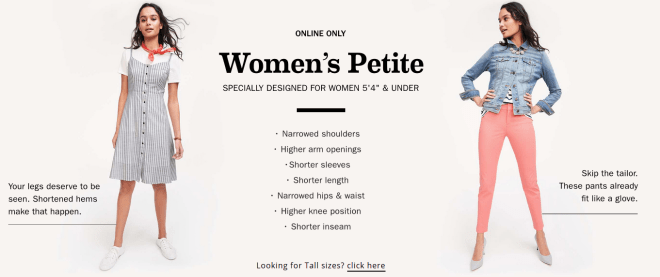
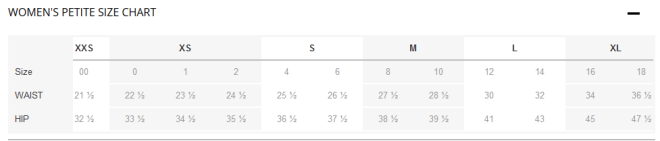
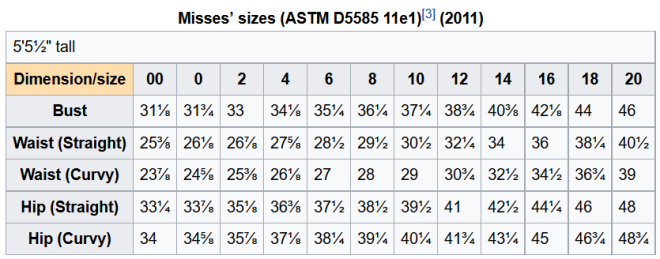
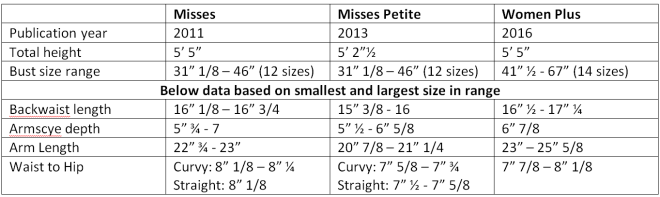

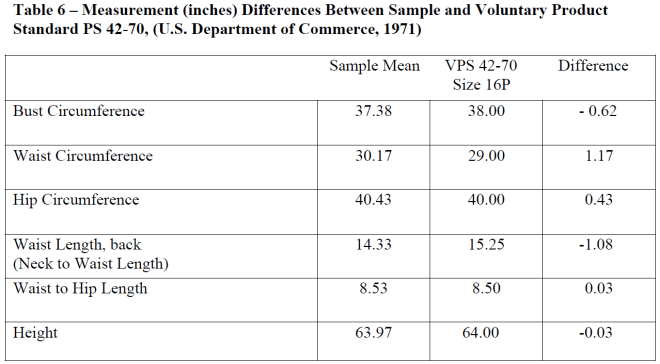
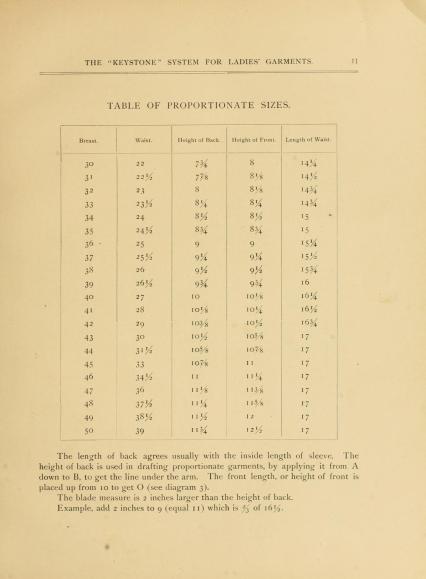
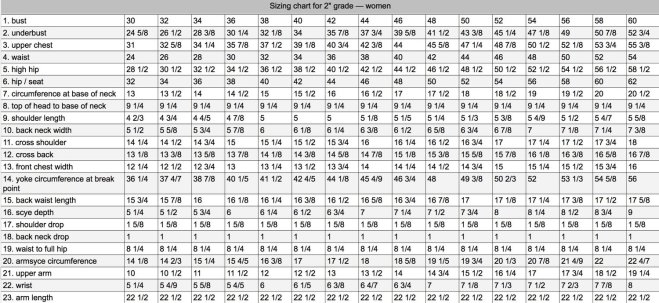

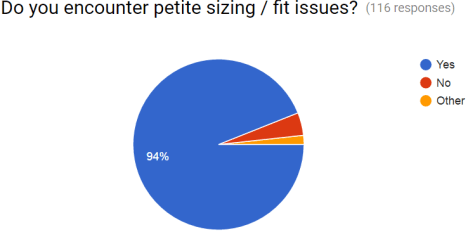
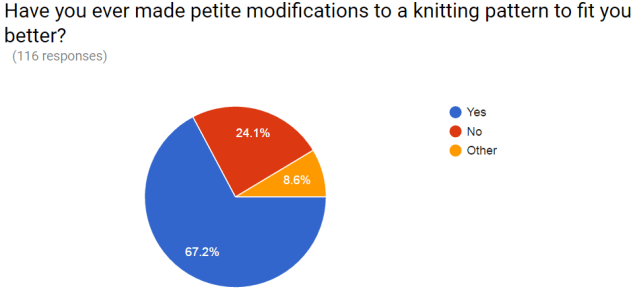
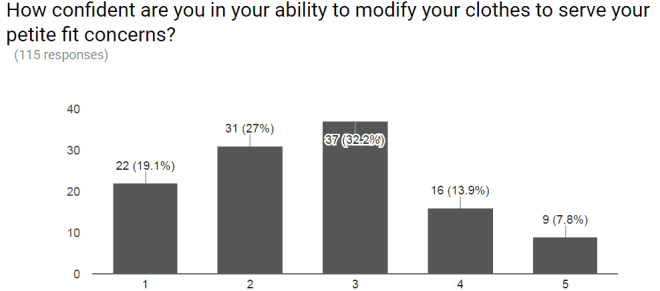

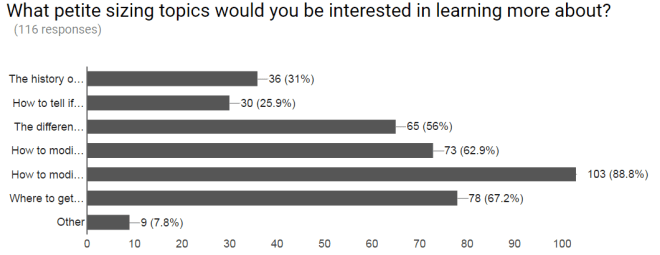
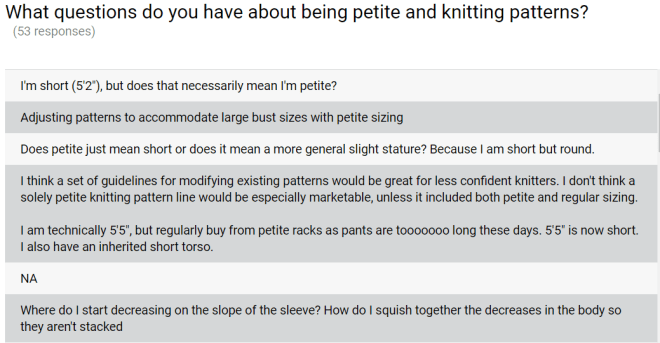
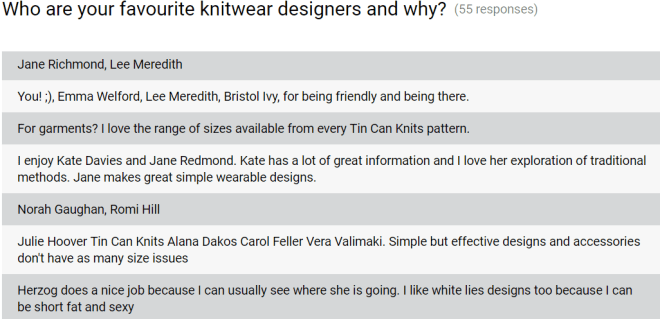
 Canary Knits