#KnitPetiteProject: Your personal variety of modifications; what are they, and how do they differ from the sizing charts?

Our last post where we looked at petite plus fit issues.
The #KnitPetiteProject plan.

All other #KnitPetiteProject posts.

The #KnitPetiteProject now has a Ravelry group. Join us!

In May we touched on diagnosing fit issues, and comparing them to the often utilized CYC sizing charts.

In June, we’re getting focused on tactics to petite your knits, always keeping in mind:

  • comparing petite measurements to “regular” CYC charts
  • “diagnosing” fit issues
  • deciding how we feel about fit
  • determining tools to alter fit to our liking
  • learning to identify patterns that work for our taste and/or are easily modifiable
  • and very importantly, considering how we differ from a general sizing chart so we have a set of general rules to consider before we begin knitting a pattern1

This week’s topic is big and unwieldy; we’re all different in so many ways, that sets of rules will never cover everyone entirely. In order to determine our personal variety of modifications and how we differ from sizing charts, each of us has to:

  1. look at our own shape and become familiar with it
  2. understand the fit we want to achieve
  3. look carefully at the constructs we are presented with (that is, understand in general what size and shape patterns are likely to assume we are)

As Marta Alto and Patti Palmer say in their book Fit for Real People,

Confusion guaranteed! 2

I insert this quote not to make you feel intimidated, but instead to emphasize that we’re all different, and that you always have to check the evidence your body gives you against any guidelines.

Look at your shape and become familiar with it

Our end goal is to be proactive in our choices and alterations of knitting patterns so that we can make informed decisions before purchase, and have an understanding of what we can and want to alter within any given pattern to deliver our desired fit.

To make that happen, a good first step is to be aware of our own body’s shape; this is not necessarily easy or simple to know! Just think about what we’ve already addressed in the #KnitPetiteProject, and the evidence given to us through the responses to the fit survey!

Because this is such a hugely variable topic, it’s useful to have an example to point to. And of course, I can always find a willing participant in… myself! So forgive me for splashing my face here again in order to illustrate a point.

One of the tools I’ve used to help gain some objective perspective on my own shape is creating a Body Graph through the methods outlined in Alto and Palmer’s book, Fit for Real People. I’ve referenced this book before; I know we’re all knitters here, and that this is a book for sewists, but I still want to recommend it to you all as a great source of information about fit and gaining an understanding of your shape and diagnosing fit issues.

You’ll find the information on creating the graph on pages 61 – 73. The value in getting this book and doing this for yourself is that you get:

  • step-by-step instructions on creating the graph
  • points on interpretation, allowing you to understand how your own shape compares to the sizing standard that the authors are referring to (in this case, the charts used throughout the home sewing industry)
  • and perhaps most importantly, the authors share a number of real life examples which serve to illustrate how everyone deviates from a sizing chart, and provides tips for sewists (and maybe even knitters, we’ll get to that in July!) on how to take control of fit

Plus, I think it would be a fantastic exercise for us to share about in the #KnitPetiteProject Ravelry group so we can all learn together!

So, here’s my experience creating the graph, interpreting it, and how I want to use this information moving forward.

Creating the Graph
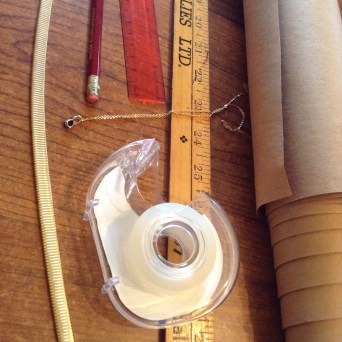
IMG_5298

From start to finish, the graph took about 45 minutes to set up and create. The tools I needed were:

  • a sharp pencil
  • a rigid ruler (I used a yardstick)
  • a chain necklace
  • a belt/piece of string
  • about 6.5′ of brown craft paper
  • tape
  • scissors
  • a contrasting colour pen
  • a bit of blank wall space
  • a willing friend!

I’m not giving away all the steps and charts, as that’s copyright material from the book. But I will say that they guide you very clearly through how to stand, how to get your friend to mark your shape at about 10 different points, and then how to subsequently fold up that paper into 8 equal chunks for interpretation.

You may wonder why we need a belt and a necklace? Wearing those two items helps to mark out a couple points on your body that would otherwise be a bit tricky to note (where your neck meets your shoulders, and your waistline).

Interpreting the Graph

As I mentioned earlier, the authors of Fit for Real People are using the home sewing sizing charts as their comparison. These aren’t exactly the same as every knitting pattern you’ll come across, but because they give you a firm set of numbers, you can compare this information against whatever information you find on a knitting pattern schematic.

There’s useful interpretive information sprinkled throughout the book, but the pages most directly connected to this are 67 – 71.

By creating this chart and reading the interpretation from the book, I’ve had some ideas about my own shape reinforced, and I’ve learned some new things as well, including:

  • the slope of my shoulders (shoulder shape is important to fitting a sweater!)
  • the proportion of my legs to my body (important for understanding more about torso length for your sweaters!)
  • the location of my waist compared to my underarms, and the depth from my shoulder to my underarm (important for getting yokes and sleeve cap depths correct!)
  • what my general shape objectively is (flatly, on paper!) (which can help in your understanding of aesthetics and proportion, a discussion we may have later on in the #KnitPetiteProject)
How I’ll use this information moving forward and why you should try it too

In the book there’s a full Body Graph worksheet where you can input all the interpretations of your shape (ie: short waist, sloping shoulder, etc). This is a tool I can return to in order to consider proportions, but also, and most applicably to us knitters, the Body Graph can be an incredible resource of the information needed to achieve fit goals in a very visual way.

The graph gives you a 2D visualization of your shape, but upon it you can also note the 3D measurements that are important to fit and sizing. As I listed above, it gives you an understanding of those vertical measurements and your proportion (ie: short waisted? broad shoulders?).

It’s also relatively easy, inexpensive, and low-tech to create. I’ve tried doing similar shape-interpretation exercises with photographs; these are interesting, but I’ve found them more time consuming and ultimately less accurate than an actual tracing of your own body.

I’ll be using this graph throughout the rest of the year in the #KnitPetiteProject to illustrate how we can take control of our knitting and get the fit we want. On a personal level, I’ll be using these charts to re-examine my choices and aesthetic preferences, along with deciding on my personal variety of modifications along with the information we touched on in May.

Understand the fit we want to achieve

We’ve already talked about how fit is both objective and subjective. We each have different tastes, style preferences, lifestyles, comfort-zones, emotions, occasions, etc…

To help us think a bit more deeply about the fit we want to achieve, I’ve created the small questionnaire below. By filling this out, you can gain a bit of perspective on what you like in your clothes, what you wear most, and subsequently what you feel may need to change (if anything at all!)

Fit Preferences PDF

Look carefully at the constructs we’re presented with

All this preference and shape examination is wonderful, but to get at the heart of our issues as petite knitters we need to know what and where the fit gaps are. In May we touch on diagnosing these issues; here, I want to encourage you to not only look at the CYC numbers, but also a specific pattern design.

Picking a specific design will act as a learning exercise for us over the next 3 weeks in June. This design can be something you have already knit for yourself, or it can be something new to you. With this design, we will:

  • take the information we’ve gathered about our shape and fit preferences and compare it to the pattern
  • identify any gaps in the body shape the pattern assumes and our own body, including how to determine the shape the pattern assumes
  • evaluate the pattern (what information does it include? what does it lack?)
  • learn to dissect pattern information in order to rework it to our liking

We’re getting very practical and hands-on this month! Come next week to the #KnitPetiteProject prepared with your chosen sweater pattern and your measurement, shape, and fit preference information! I’m looking forward to working and learning with you.

Please consider joining in these conversations on the #KnitPetiteProject Ravelry group so we can all learn and share together.

Question

Interested in creating your own Body Graph? Join us in this #KnitPetiteProject Ravelry group thread and let’s get learning together!

Resources

1 Amy Herzog refers to this as well in her excellent Craftsy class, Knit to Flatter. She clarifies and defines “Miss Average”, and states that while you will differ from Miss Average, you’ll “always differ in the same way”, so getting your numbers is a big and important first step.

2 Palmer, Pati and Marta Alto. Fit for Real People. Palmer/Pletsch Publishing; 2 edition. September 2006, pg 127.

#KnitPetiteProject: Your personal variety of modifications; what are they, and how do they differ from the sizing charts?

#KnitPetiteProject: Petite Plus; what are the fit issues, and how do they line up against sizing charts?

Our last post where we looked at bust, waist, and hip circumferences.
The #KnitPetiteProject plan.

All other #KnitPetiteProject posts.

The #KnitPetiteProject now has a Ravelry group. Join us!

…Youtube video coming soon…

The rest of May and June will be filled with very practical posts that will focus on:

  • comparing petite measurements to “regular” CYC charts
  • “diagnosing” fit issues
  • helping us decide how we feel about fit
  • determining tools to alter fit to our liking
  • learning to identify patterns that work for our taste and/or are easily modifiable
  • and very importantly, considering how we differ from a general sizing chart so we have a set of general rules to consider before we begin knitting a pattern1

For some of you this information may be old news, and for others, it may be brand new. If you read this and believe something should be added or changed, please let me know in the comments! It’s important that we make the #KnitPetiteProject as comprehensive, accurate, and inclusive as possible.

I’m a large but short woman. Plus sized garment patterns are entirely too long in the arms, too deep in the arm-scye, and often too wide or low in the neck. I don’t mind the extra length on the body because I like to wear tops that are long, and I can adjust that length very easily. Patterns designed for shorter women usually do not accommodate heavier women.2

A few things before we jump in to this week’s topic:

I know if something doesn’t fit me! Why should we look at “diagnosing” fit?!

Please head to May 9th’s post to read my personal story of discovering the value in diagnosing fit.

Please consider joining the #KnitPetiteProject Ravelry group so we can enable this knowledge sharing and help each other to diagnose fit issues!

Remember, Fit is a moving target!

We’ve already touched on this in previous posts, but fit is incredibly complex, and is made more so by the fact that it is both subjective to your own tastes, and dependent on the style of the garment. In the examples below, please keep that in mind (particularly style considerations).

Over the next four posts, you may see a bunch of repetition

I hope that these posts will be able to stand on their own AND fit together, so that readers can take as comprehensive an amount of information from each post as possible. Please excuse the repetition!

Body Positivity

This is worth repeating: looking at the shape of your body and measuring it is not a contest, and it’s not a judgement on your worth as a human being. This is intended to empower you to get what YOU want out of your knits.

In May we’re looking at diagnosing fit, and seeing how our numbers and general “petite” numbers compare to the “regular” numbers of the much-used CYC charts.

Let’s get started.

Petite Plus; what are the issues, and how do they line up against sizing charts?

What Are the Issues?

Width tied to Length

I wanted to devote an entirely separate post to petite plus because from personal experience, information from the #KnitPetiteProject surveys, and my own research, the petite plus knitter is very under-served and because of the way sizing systems for knitting work, petite plus folks have some particularly compounded issues in sizing.

Ysolda touch on this somewhat in her blog post introducing her new sizing chart in February. In it, she wrote:

You’ll notice that some lengths are consistent across the size range. This is because the sizing chart is based on women of the same average height across the size range. Whether larger bust sizes should also be proportionally taller is a matter of some debate, and you may wish to make slight adjustments to these measurements.

The length of the underarm to neck area *will* increase between sizes, some designers handle this by reducing the sleeve and body lengths as the sizes increase. 3 (bolded emphasis my own)

She also stated that her charts are for “average” height, which, according to my research tends to be around 5’5″.

As for how Ysolda handles lengths and widths, she states:

Personally I prefer to keep sleeve and body lengths close to the same across the size range allowing knitters to make adjustments as required for height independent of bust size. The exception is for very close fitting garments where a little extra length is required to follow the curves of the body in larger sizes.4

From this you can see the leeway, and/or the designer’s interpretation, that can go in to determining size and length.

Widths being tied to lengths in charts means that those of us on the out-sized ends of sizing systems have our numbers skewed.

In my search for a more representative sizing system, or any detailed information about petite plus sizing, I found the accomplished sewing designer Kathleen Cheetham. We’ve looked at her charts in the past.

This week she’s been kind enough to answer a few questions for us here in the #KnitPetiteProject about her sizing system and petite plus folks. AND, give us a few coupon codes! Check them out at the bottom of her interview.


SmilingWManneq2
Kathleen Cheetham

#KnitPetiteProject QUESTION: Your work in petite plus sizing is so important! I love how your Petite Plus Patterns® are designed specifically women with “narrow shoulders, D cup bra, rounded tummy!” With these fit aspects in mind, I’m wondering: What fit sacrifices does a petite person make when wearing a non-petite sized garment? What are some of the tell-tale signs that a garment (particularly tops) isn’t sized for a petite (and petite plus) body?

KC ANSWER: We often think of length as being the issue in fit for petite women wearing regular-sized garments. More than length though is scale and proportion – the width of the shoulders, depth of the neckline and armhole, the overall scale of collars, cuffs and pockets are all too big for the tinier figure.

#KnitPetiteProject QUESTION: I really appreciate that your resources are designed specifically for petite plus women! It’s difficult to find information on this topic, and I’ve found your book “Perfect Plus” to be a great help in understanding petite plus fit concerns. One of my favourite parts of your book is your body measurements chart.

For all the #KnitPetiteProject readers I’d love to know: how is your chart different from other charts and what sources of data did you use to create your sizing chart?

KC ANSWER: I developed my measurement chart from data compiled from a number of sources including, – standard measurement charts in place for decades within the pattern drafting industry and my own research, measuring actual petite women.

#KnitPetiteProject QUESTION: How is sizing in sewing different than sizing in knitting? Should a petite (and petite plus) knitter be concerned about the sorts of petite modifications you suggest in your book?

KC ANSWER: I am not a knitter, but I’m sure that the same concerns of fit with regard to length, scale and proportion will be of concern to knitters as to sewers.


You can find more from Kathleen at her website here: Petite Plus Patterns

Join her Petite Plus Patterns Facebook

Interested in learning more from Kathleen? The Threads class, called Plus Size Petite: Tops and Tummies can be seen online or purchased as a video through Taunton Press’ web site. This link will take you to more information and a 20% off discount.

Kathleen has taught five classes through Craftsy, four which relate to fitting specific areas of the body and one that teaches how to grade patterns up and down in size.

Check out the classes:

  • Create any Size, Pattern Grading for Sewers: Coupon Details: Get 33% off the full retail price of select Craftsy classes taught by Kathleen Cheetham. Cannot be combined with any other coupons. Expires August 1, 2017.
  • Custom Fitting: Back, Neck and Shoulders: Coupon Details: Get 33% off the full retail price of select Craftsy classes taught by Kathleen Cheetham. Cannot be combined with any other coupons. Expires August 1, 2017.
  • Adjust the Bust: Coupon Details: Get 33% off the full retail price of select Craftsy classes taught by Kathleen Cheetham. Cannot be combined with any other coupons. Expires July 20, 2017.
  • Custom Fitting: Waist and Hips: Coupon Details: Get 33% off the full retail price of select Craftsy classes taught by Kathleen Cheetham. Cannot be combined with any other coupons. Expires August 1, 2017.
  • Plus Size Pant Fitting: Coupon Details: Get 33% off the full retail price of select Craftsy classes taught by Kathleen Cheetham. Cannot be combined with any other coupons. Expires August 1, 2017.

Also, for us knitters, Kathleen recommends this Craftsy class:

  • Sweater Modifications for a Custom Fit by Amy Herzog: Coupon Details: Get 25% off the full retail price of any Craftsy class. Excludes classes from our special Mastering in Minutes series as well as from our partner, The Great Courses. Cannot be combined with any other coupons. Expires August 1, 2017.

How do the issues line up against sizing charts?

CYC Sizing Charts

We’ve talked a bit about the CYC sizing charts here on the #KnitPetiteProject before, and I’d like to use them again here to illustrate some differences and act as a bit of a base level from which to operate.

We can’t assume EVERY knitting pattern we come across uses CYC! But many do, and if you find that you experience similar fit issues across knitting pattern designs then looking at the CYC charts may be helpful.5

cyc
CYC Woman Size Charts

As Palmer and Alto point out in their book Fit for Real People, going solely by measurement numbers can misrepresent fit; they note that you could pick a size that has the same measurements as your body, but you may still experience excess fabric, tight pull lines, or other fit issues because of the complexity of our body’s shape. For our learning exercise here, let’s take these numbers as a starting point as we put together the puzzle of fit and trying to determine what general fit alterations we can consider for knitting patterns before we start knitting them!

You’ll notice that these CYC charts have nine different points of measurement, and that they include sizes up to a 62″ bust circumference.

All these numbers can help you in estimating the shape of your body and the shape of the body in patterns designed using these charts. Remember: not ALL patterns use these charts, but many do.

Bust

Last week I prompted to you to take a closer look at the bust measurement, and try instead to use your high bust (or upper torso) measurement to select a size.

Pretending that this number is actually your bust measurement. Does that set of numbers come closer to your own measurements?

This piece of advice comes from a variety of sources including Ysolda and Amy Herzog; picking size based on upper torso instead of bust will let you know more about your actual frame, and may provide you with a set of numbers that is closer to your actual numbers. This is particularly of use for petite plus folks.

Sleeve Length

As you trace your finger along the chart to the larger sizes, you’ll see the sleeves grow inches longer. The same happens for the armhole depth. As Ysolda points out, larger sizes may indeed need longer lengths in the underarm to neck region. Is this number close to your own measurement?

Back Waist

Particularly, take a look at the back waist length. One of the larger sizes, the 50″ bust, is 18″ long. For comparison, the charts from Kathleen Cheetham give a back waist measurement of 14″ 7/8. Which sizing chart is closer to your measurements? Do Kathleen’s charts better represent your body?

Cross Back

Do the same with the cross back measurement from CYC and Kathleen’s charts. There’s a pretty stark difference in width! Which chart better reflects your size?

Question

As a petite plus knitter, what are your favourite sweater patterns?

Resources

1 Amy Herzog refers to this as well in her excellent Craftsy class, Knit to Flatter. She clarifies and defines “Miss Average”, and states that while you will differ from Miss Average, you’ll “always differ in the same way”, so getting your numbers is a big and important first step.

2 Anonymous #KnitPetiteProject Fit Survey respondent.

3 Ysolda’s Sizing Charts for Knitwear Designers, 2017. Accessed May 8, 2017.

4 Ibid

5 I take that this is a good piece of advice because author Anne Marie Soto gives very similar instruction in her article “Petite Pizzaz” from Vogue Knitting Winter 92-93: “In patterns for home sewing…both Miss and Miss Petite sizes have been standardized. Thus, the measurements in home-sewing patterns can serve as useful guidelines for altering Misses knitting instructions to suit your smaller frame.” pg 16.

Save

Save

#KnitPetiteProject: Petite Plus; what are the fit issues, and how do they line up against sizing charts?

#KnitPetiteProject: Bust, waist, and hip circumferences; what are the fit issues, and how do they line up against sizing charts?

Our last post where we looked at torso length measurements and shapes.
The #KnitPetiteProject plan.

All other #KnitPetiteProject posts.

The #KnitPetiteProject now has a Ravelry group. Join us!

The rest of May and June will be filled with very practical posts that will focus on:

  • comparing petite measurements to “regular” CYC charts
  • “diagnosing” fit issues
  • helping us decide how we feel about fit
  • determining tools to alter fit to our liking
  • learning to identify patterns that work for our taste and/or are easily modifiable
  • and very importantly, considering how we differ from a general sizing chart so we have a set of general rules to consider before we begin knitting a pattern1

For some of you this information may be old news, and for others, it may be brand new. If you read this and believe something should be added or changed, please let me know in the comments! It’s important that we make the #KnitPetiteProject as comprehensive, accurate, and inclusive as possible.

Of course, it’s unlikely that you’ll find every single one of your measurements is the same as the pattern, focus on the key measurements of shoulders, waist (for this purpose use the narrowest part of your torso not necessarily your natural waist line) and hip. Vertical measurements are generally easiest to adapt so don’t use those to determine the size you make but note any changes you’ll need to make, such as lengthening the body, moving the waist shaping higher, etc.2

A few things before we jump in to this week’s topic:

I know if something doesn’t fit me! Why should we look at “diagnosing” fit?!

Please head to May 9th’s post to read my personal story of discovering the value in diagnosing fit.

Please consider joining the #KnitPetiteProject Ravelry group so we can enable this knowledge sharing and help each other to diagnose fit issues!

Remember, Fit is a moving target!

We’ve already touched on this in previous posts, but fit is incredibly complex, and is made more so by the fact that it is both subjective to your own tastes, and dependent on the style of the garment. In the examples below, please keep that in mind (particularly style considerations).

Over the next four posts, you may see a bunch of repetition

I hope that these posts will be able to stand on their own AND fit together, so that readers can take as comprehensive an amount of information from each post as possible. Please excuse the repetition!

Body Positivity

This is worth repeating: looking at the shape of your body and measuring it is not a contest, and it’s not a judgement on your worth as a human being. This is intended to empower you to get what YOU want out of your knits.

In May we’re looking at diagnosing fit, and seeing how our numbers and general “petite” numbers compare to the “regular” numbers of the much-used CYC charts.

Let’s get started.

Bust, waist and hip circumferences; what are the issues, and how do they line up against sizing charts?

What Are the Issues?

You might be surprised to see this topic addressed in the #KnitPetiteProject, as I think I’ve been quite chatty about how we’re focusing on vertical measurements and modifications. But, as we’ve seen over the past few months (and the last couple of posts in particular) the collection of shapes and lengths and circumference of our body affect each other, so it’s important to touch on these circumference measurements as well.

Bust

It’s also important to reflect on these numbers because, as we read in March’s #KnitPetiteProject posts, circumferences, particularly bust measurements, are how sizes are selected, systems are structured, and are the number that you’ll likely find listed in the “sizes” section of your knitting pattern.

This has use, and any sizing system needs certain primary numbers to structure the rest of its sizing around. But for us, it’s important to remember that the bust number is only a starting point, and doesn’t have to be the ultimate signifier of your size.3

Some evidence that basing your size on your bust measurement gives you a knit that’s too large for your frame:

  • you may have excess fabric around your neck and shoulders
  • vertical measurements are too long
  • any shoulder and sleeve cap seams dip down off your shoulders
  • necklines are deeper than the pattern style demonstrates

Some evidence that basing your size on your bust measurement gives you a knit that’s too small for your frame:

  • your knit may stretch and look and feel tight, particularly around your shoulders
Waist

This is another important circumference number, and within sizing systems is tied to the other numbers proportionally in that a hourglass or curvy shape is usually presumed. You may need more or less waist shaping for your garment, and determining this is fairly straightforward.

Locating one’s waist for measuring may not be as straightforward; you can check out the tips in this post from February for more info.

That said, seeing the waist circumference through a petite lens means that the shaping you may have to add or subtract may have to be done over fewer rows than a “regular” size.

Also of note: the studies we’ve looked at in earlier #KnitPetiteProject posts4 have research that shows the petite person may be more likely to have a smaller bust:waist ratio than “regular” sizes.  If this is the case, you may encounter fit issues in your sweaters where the bust fits, but the waist is too small.

Hips

Same goes for the hip circumference. Research has found that the difference in ratio between these three circumferences is smaller than in “regular” sizing, resulting in a straighter body shape for petite people than for “regulars”.

How do the issues line up against sizing charts?

CYC Sizing Charts

We’ve talked a bit about the CYC sizing charts here on the #KnitPetiteProject before, and I’d like to use them again here to illustrate some differences and act as a bit of a base level from which to operate.

We can’t assume EVERY knitting pattern we come across uses CYC! But many do, and if you find that you experience similar fit issues across knitting pattern designs then looking at the CYC charts may be helpful.5

cyc
CYC Woman Size Charts

As Palmer and Alto point out in their book Fit for Real People, going solely by measurement numbers can misrepresent fit; they note that you could pick a size that has the same measurements as your body, but you may still experience excess fabric, tight pull lines, or other fit issues because of the complexity of our body’s shape. For our learning exercise here, let’s take these numbers as a starting point as we put together the puzzle of fit and trying to determine what general fit alterations we can consider for knitting patterns before we start knitting them!

You’ll notice that these CYC charts have nine different points of measurement, including bust, waist, and hips circumference.

All these numbers can help you in estimating the shape of your body and the shape of the body in patterns designed using these charts. Remember: not ALL patterns use these charts, but many do.

Bust

Look at this chart: if you selected your size based on your bust measurement, how close are the other numbers to your own?

Now, take you upper torso (or high bust) measurement. Pretend that this number is actually your bust measurement. Does that set of numbers come closer to your own measurements?

This piece of advice comes from a variety of sources including Ysolda and Amy Herzog; picking size based on upper torso instead of bust will let you know more about your actual frame, and may provide you with a set of numbers that is closer to your actual numbers.

Waist and Hips

Check out the ratios of waist to hips. They hover around a 10″ – 12″ difference. Is this an accurate ratio for you? Perhaps your own petite body supports the evidence of the study noted below. Personally, my waist:hips difference is about 10″ (BUT, selecting a size based on my upper bust measurement at least brings some of the vertical measurements down and closer to my actual size).

In June we’ll be going over the details of tactics to petite your knits. For now, let’s all look at those numbers and pull those FOs out and see what evidence of fit we have. Ask yourself these questions:

  1. What information do my numbers compared to the CYC numbers tell me?
  2. Is that information supported in the fit of my handknits?
  3. Is that information supported in the fit of my store-bought clothes?

Question

Does your high bust (or upper torso) measurement give you numbers that more accurately reflect your size in the CYC charts?

Resources

1 Amy Herzog refers to this as well in her excellent Craftsy class, Knit to Flatter. She clarifies and defines “Miss Average”, and states that while you will differ from Miss Average, you’ll “always differ in the same way”, so getting your numbers is a big and important first step.

2 Ysolda Teague. Little Red in the City. April, 2011, pg 37.

3 Ysolda Teague. Little Red in the City. April, 2011. Ysolda’s book Little Red in the City goes into great detail about different sizes and shapes, selecting a size, and includes many designs that are created to be easy for you to modify to your own numbers.

4 Youngsook Kim , Hwa Kyung Song , Susan P. Ashdown , (2016) “Women’s petite and regular body measurements compared to current retail sizing conventions“, International Journal of Clothing Science and Technology, Vol. 28 Iss: 1, pg 56.

5 I take that this is a good piece of advice because author Anne Marie Soto gives very similar instruction in her article “Petite Pizzaz” from Vogue Knitting Winter 92-93: “In patterns for home sewing…both Miss and Miss Petite sizes have been standardized. Thus, the measurements in home-sewing patterns can serve as useful guidelines for altering Misses knitting instructions to suit your smaller frame.” pg 16.

Save

Save

#KnitPetiteProject: Bust, waist, and hip circumferences; what are the fit issues, and how do they line up against sizing charts?

#KnitPetiteProject: Torso length measurements; what are the issues, and how do they line up against standard sizing?

Our last post where we looked at shoulder, back, and arm measurements and shapes.
The #KnitPetiteProject plan.

All other #KnitPetiteProject posts.

The #KnitPetiteProject now has a Ravelry group. Join us!

The rest of May and June will be filled with very practical posts that will focus on:

  • comparing petite measurements to “regular” CYC charts
  • “diagnosing” fit issues
  • helping us decide how we feel about fit
  • determining tools to alter fit to our liking
  • learning to identify patterns that work for our taste and/or are easily modifiable
  • and very importantly, considering how we differ from a general sizing chart so we have a set of general rules to consider before we begin knitting a pattern1

For some of you this information may be old news, and for others, it may be brand new. If you read this and believe something should be added or changed, please let me know in the comments! It’s important that we make the #KnitPetiteProject as comprehensive, accurate, and inclusive as possible.

…patterns are designed for a height of 5’5″ – 5’6″. If you are 5’2″ and very long-waisted in proportion to your height, the pattern waist length may be fine. It won’t be, however, if your waist length is proportionally average or less than average for your height.2

A few things before we jump in to this week’s topic:

I know if something doesn’t fit me! Why should we look at “diagnosing” fit?!

Please head to May 9th’s post to read my personal story of discovering the value in diagnosing fit.

Please consider joining the #KnitPetiteProject Ravelry group so we can enable this knowledge sharing and help each other to diagnose fit issues!

Remember, Fit is a moving target!

We’ve already touched on this in previous posts, but fit is incredibly complex, and is made more so by the fact that it is both subjective to your own tastes, and dependent on the style of the garment. In the examples below, please keep that in mind (particularly style considerations).

Over the next four posts, you may see a bunch of repetition

I hope that these posts will be able to stand on their own AND fit together, so that readers can take as comprehensive an amount of information from each post as possible. Please excuse the repetition!

Body Positivity

This is worth repeating: looking at the shape of your body and measuring it is not a contest, and it’s not a judgement on your worth as a human being. This is intended to empower you to get what YOU want out of your knits.

In May we’re looking at diagnosing fit, and seeing how our numbers and general “petite” numbers compare to the “regular” numbers of the much-used CYC charts.

Let’s get started.

Torso Length measurements; what are the issues, and how do they line up against sizing charts?

What Are the Issues?

In her article “Petite Pizzaz” in Vogue Knitting Winter ’92 – ’93, Anne Marie Soto notes three separate zones in which a petite person may want to proportionately alter their knitted sweater to fit them better, particularly if that sweater is one that is intended to fit close to the body.

These three zones correspond with the torso roughly with the upper chest, the midriff, and the hipline. For the purposes of this post, let’s divide up the torso in roughly the same way the CYC numbers do: armhole depth, back waist length, and (an addendum to CYC) the choices you can make for the total length of your sweater.

Armhole Depth

This area can be long or short depending on a variety of factors; if you read the post from May 9 it will show you just how many different ways your shoulders and back can be shaped.

Those factors affect your fit as well as the ultimate depth of your armhole. How can you tell if you are shorter in the armhole depth than the pattern assumes you are?3

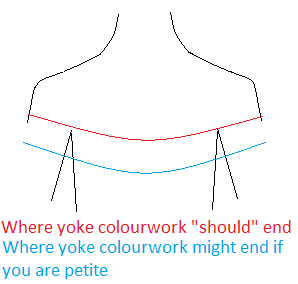
yoke
Comparing an imaginary pattern’s yoke depth with how that pattern might look on someone with a short armhole depth
  • necklines dip lower on your upper torso than the pattern image demonstrates it was designed to
  • you may have gaping in the neckline; this is often seen in women who have a full bust and select their size based on the bust number, with the consequence being there is an excess of fabric at the upper chest and neckline (depending on neckline style)
  • if yoke details extend down onto your bust, and/or the armpit of the sleeve is significantly lower on your body than the modeled images, you may have a shorter armhole depth than the pattern assumes
Back Waist Length

This is another area that many respondents to the #KnitPetiteProject fit survey noted they need to alter. As we’ve been over earlier this year, there are many different ways a person can be petite, and just because you’re shorter than 5’4″ doesn’t mean you also have a shorter-than-sizing-charted back waist length.

But, here’s some ways to determine if this is an issue for you:

  • on a shaped sweater, where does the waist shaping hit you? How about the bust shaping? If the waist shaping is sitting down closer to your hips, you may have a short back waist
  • as with any measurement, this is affected by all your other shapes, including bust circumference; while that is a horizontal measurement, it’s important to keep in mind that a larger surface like a bust takes up more length as well as width. This could cascade in altering where a sweater’s back waist lands on your body4
Hipline Length

This is not a measurement you’ll find on the CYC chart, but it is a number that’s quite important for the look of your garment. This is also likely something you’ve encountered before, with a hip length sweater ending up looking like a tunic, for example.

You might have a hipline length that is shorter than the pattern assumes if:

  • a sweater picture in a pattern photo appear to end at the top of the wearer’s hip bone, but extends further down your body to create a more “tunic” length

How do the issues line up against sizing charts?

CYC Sizing Charts

We’ve talked a bit about the CYC sizing charts here on the #KnitPetiteProject before, and I’d like to use them again here to illustrate some differences and act as a bit of a base level from which to operate.

We can’t assume EVERY knitting pattern we come across uses CYC! But many do, and if you find that you experience similar fit issues across knitting pattern designs then looking at the CYC charts may be helpful.5

cyc
CYC Woman Size Charts

As Palmer and Alto point out in their book Fit for Real People, going solely by measurement numbers can misrepresent fit; they note that you could pick a size that has the same measurements as your body, but you may still experience excess fabric, tight pull lines, or other fit issues because of the complexity of our body’s shape. For our learning exercise here, let’s take these numbers as a starting point as we put together the puzzle of fit and trying to determine what general fit alterations we can consider for knitting patterns before we start knitting them!

You’ll notice that these CYC charts have nine different points of measurement, including armhole depth and back waist length. You’ll also notice, however, that they do not have information on total length, or length from waist to hipline.

All these numbers can help you in estimating the shape of your body and the shape of the body in patterns designed using these charts. Remember: not ALL patterns use these charts, but many do.

Armhole Depth

How does your armhole depth measure against these numbers? We went over taking measurements back in February, but there is no shortage of places where you can find good, reliable information on taking measurements including the incredibly comprehensive Principles of Knitting by June Hemmons Hiatt, especially in Chapter 24, Measurements and Schematics.

Is there a difference between your numbers, and can you see evidence of this in your FOs? Do you feel confident in “diagnosing” this fit?

Back Waist Length

In her “Petite Pizzaz” article for Vogue Knitting, Anne Marie Soto notes the back waist length as one of the ways in which petite sizes differ from Misses sizes (remember, Soto is basing her numbers and advice on the long established sizing charts for the home sewing industry). She states:

For petites, the back waist length (from the neck base to the waist in back) is 1″ (2.5cm) shorter.6

Hipline Length

Soto also notes that the hipline length is different for petites. Here, she writes:

The hipline (at the fullest part of the hip) is 2″ (5cm) higher – it’s 7″ (18cm) below the waist for Petites, compared to 9″ (23cm) below the waist for Misses. As a result, the length of a finished Petite sweater (measured from the waistline to the hemline at the center back) is 2″ (5cm) shorter.7

While 2″ may not sound like much, it really can make quite a difference, even if all else is equal. Those extra inches in length may make a sweater go from hip length to tunic, or nearly tunic.

And don’t forget if that waistline-to-hipline length is compounded by other short lengths in your sweater. If you are overall shorter in armhole depth, back waist, and hipline, length issues can cascade down and lower that hemline even further.

In June we’ll be going over the details of tactics to petite your knits. For now, let’s all look at those numbers and pull those FOs out and see what evidence of fit we have. Ask yourself these questions:

  1. What information do my numbers compared to the CYC numbers tell me?
  2. Is that information supported in the fit of my handknits?
  3. Is that information supported in the fit of my store-bought clothes?

Question

Do you have expertise in fitting? Or maybe you have questions about determining your fit issues? If so, please hop over to the this #KnitPetiteProject Ravelry Group thread where you can share your questions, and provide answers!

Resources

1 Amy Herzog refers to this as well in her excellent Craftsy class, Knit to Flatter. She clarifies and defines “Miss Average”, and states that while you will differ from Miss Average, you’ll “always differ in the same way”, so getting your numbers is a big and important first step.

2 Patti Palmer and Marta Alto. Fit for Real People: Sew great clothes using ANY pattern. Palmer/Pletsch Publishing, 2006, pg 115.

3 Info for this section from Patti Palmer and Marta Alto. Fit for Real People: Sew great clothes using ANY pattern. Palmer/Pletsch Publishing, 2006, pgs 129 – 132.

4 Ysolda Teague. Little Red in the City. April, 2011, pg 53. As Ysolda writes in Little Red in the City, “In my experience, it’s actually more common for busty women to need … extra length, rather than any extra width, in order to achieve a good fit.”

5 I take that this is a good piece of advice because author Anne Marie Soto gives very similar instruction in her article “Petite Pizzaz” from Vogue Knitting Winter 92-93: “In patterns for home sewing…both Miss and Miss Petite sizes have been standardized. Thus, the measurements in home-sewing patterns can serve as useful guidelines for altering Misses knitting instructions to suit your smaller frame.” pg 16.

6 Anne Marie Soto. Petite Pizzaz. Vogue Knitting. Winter 92-93, pg 16.

7 Ibid.

Save

Save

#KnitPetiteProject: Torso length measurements; what are the issues, and how do they line up against standard sizing?

#KnitPetiteProject: Shoulders, back and arms; what are the issues, and how do they line up against sizing charts?

Our last post where we compared the same knitted garments on a petite and non-petite person.
The #KnitPetiteProject plan.

All other #KnitPetiteProject posts.

The #KnitPetiteProject now has a Ravelry group. Join us!

The rest of May and June will be filled with very practical posts that will focus on:

  • comparing petite measurements to “regular” CYC charts
  • “diagnosing” fit issues
  • helping us decide how we feel about fit
  • determining tools to alter fit to our liking
  • learning to identify patterns that work for our taste and/or are easily modifiable
  • and very importantly, considering how we differ from a general sizing chart so we have a set of general rules to consider before we begin knitting a pattern1

For some of you this information may be old news, and for others, it may be brand new. If you read this and believe something should be added or changed, please let me know in the comments! It’s important that we make the #KnitPetiteProject as comprehensive, accurate, and inclusive as possible.

…the design of the upper bodice areas of a garment – the shoulder, armhole, and sleeve – which are without question the most challenging aspects of a pattern.2

A few things before we jump in to this week’s topic:

I know if something doesn’t fit me! Why should we look at “diagnosing” fit?!

I want to share my own story with you about learning to really see the way something fits me in the hopes that it may be helpful or interesting to you.

My interest in fit was awakened a few years ago when I really started making a lot of my own clothes, both knitted and sewn. I would finish a project, happily try it on, and immediately notice all the places where it “looked weird”.

The result of this with my first few projects was a tedious and frustrating re-doing of things in a vain attempt to correct my “mistakes”. Because clearly I had made mistakes! The clothes I made looked weird and didn’t fit right!

It wasn’t until I decided to try on store-bought clothes I had owned and worn for years and compare them to my own finished projects that I realized something: the weird looking “mistakes” I had made in my own handmade clothes appeared in my store bought ones as well! It was a big revelation to me that the weird fit I didn’t like in my own handmade clothes wasn’t from my mistakes in making the pattern, it was representative of consistent issues I experience, even in store-bought clothes.

All my life I had ignored or innately accepted the fit of store bought clothes; but when the same issues came up with my handmade clothes, I only really “saw” them because I was being self-critical of my own product!

Once I had that realization, I focused on figuring out why those consistent “weird fit” things kept happening. And let me tell you, the answer wasn’t as easy to find, or figure out, or “diagnose”, as I thought it would be. It took a lot of digging and reading and looking at illustrations to even start to get there.

What I really want for these next few posts, and for the #KnitPetiteProject in general, is to save YOU from such a struggle to diagnose and alter those fit issues you may want to change. I want to share what I’ve read and learned, AND draw on the expertise of all you kind readers, to create this resource we as petite knitters can all go to. I think it would be amazing if those of us with experience in looking at and diagnosing fit can advise other who may not know or can’t figure out what their fit issues is.

Please consider joining the #KnitPetiteProject Ravelry group so we can enable this knowledge sharing and help each other to diagnose fit issues!

Remember, Fit is a moving target!

We’ve already touched on this in previous posts, but fit is incredibly complex, and is made more so by the fact that it is both subjective to your own tastes, and dependent on the style of the garment. In the examples below, please keep that in mind (particularly style considerations).

Over the next four posts, you may see a bunch of repetition

I hope that these posts will be able to stand on their own AND fit together, so that readers can take as comprehensive an amount of information from each post as possible. Please excuse the repetition!

Body Positivity

This is worth repeating: looking at the shape of your body and measuring it is not a contest, and it’s not a judgement on your worth as a human being. This is intended to empower you to get what YOU want out of your knits.

The next 4 weeks we’re looking at diagnosing fit, and seeing how our numbers and general “petite” numbers compare to the “regular” numbers of the much-used CYC charts.

Let’s get started.

Shoulders, back and arms; what are the issues, and how do they line up against sizing charts?

What Are the Issues?

Shoulders

Sweaters “hang” from your shoulders, and so achieving the sort of fit you want in that part of the body is important, and effects the way the rest of the look of the sweater on your body.

Petite people have shoulders of all different shapes and widths and heights and slopes. Every person’s body is different, and you’ll likely have other fit aspects to consider.

Taking shoulders alone, though, how can you diagnose fit issues?3

shoulders

Square Shoulders

You might have shoulders that are more square than the pattern assumes if:

  • any existing sleeve cap seam doesn’t sit on your shoulder’s protruding bone (it may be pulled closer to your neck), or looks different on you than the images in the pattern photo4
  • the sweater feels tight across your upper back and upper chest; you may see pulling lines across the back of your shoulders

Sloping Shoulders

You might have shoulders that are more sloping than the pattern assumes if:

  • any existing sleeve cap seam doesn’t sit on your shoulder’s protruding bone (it may dip down lower than your shoulder bone)

Uneven Shoulders

You might have shoulders that are more uneven than the pattern assumes if:

  • the fit effects mentioned above happen on one side of your body but not the other
  • looking at yourself in the mirror, the lower shoulder might make that arm appear a bit longer than the higher shoulder

Broad Shoulders

You might have shoulders that are more broad than the pattern assumes if:

  • any seams on the shoulders appear to be pulling in towards each other across your upper chest

Narrow Shoulders

You might have shoulders that are more narrow than the pattern assumes if:

  • any seams on the shoulders fall down off your shoulders
  • the sweater has extra fabric bagging around your armpits, across your upper chest and back

Forward Shoulders

You might have shoulders that are more forward than the pattern assumes if:

  • the shoulder seam line sits angled toward your back instead of toward the tip of your shoulder bone
Back

As you’ve probably already seen, determining the fit of shoulders and back are connected. Everyone will have their own unique collection of shapes in their body, some of which will interact directly with others. But, taking shoulders alone, what are a number of ways your back can be shaped differently from a pattern, and how can you tell what that shape is?

back

Broad Back

You might have a back that is broader than the pattern assumes if:

  • when you reach forward, there is tightness across the front of the upper sleeve area
  • any seams for the armhole don’t reach to your actual arm
  • you may have tightness across your back that shows up as pull lines; this might be confused for broad shoulders, but THOSE pull lines will be higher on your back, closer to the top of your shoulders. In knitting those pull lines will show up as the fabric stretching, because knitted fabric generally has a degree of elasticity

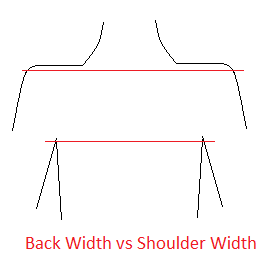
backvshoulder

Narrow Back

You might have a back that is narrower than the pattern assumes if:

  • there’s excess material in the back of your sweater, which may appear as vertical lines running down your back; this issue might be familiar to full busted women who choose a size based on their bust, but have a narrow back
  • any armhole seams might dip out onto your arm
  • it may be easy to confuse a narrow back for narrow shoulders and vice versa; diagnose narrow back by looking at what the fabric is doing nearer to your armpits rather than up at the top of your shoulders

Round Back

Your back can be round in a variety of ways, including slightly rounded, rounded high, or very round. You might have a back that is rounder than the pattern assumes if:

  • there’s gaping at your back armhole; you might have a slightly rounded back
  • there’s gaping at your back neckline; you might have a high round back
  • there’s large gaping holes at the arms and the front neckline might be riding up against your neck; you might have a very round back

Sway or Flat Back

We all have different postures and shapes to our spine, which will affect the way a sweater sits on our body. You might have a back that is more swayed or flatter than the pattern assumes if:

  • you have excess fabric pooling in folds at the small of your back (this would be your back waist); you might have a sway back
  • your hem is longer in the back than in the front; you might have a flat back
Arms

This is one area that many people have responded on the #KnitPetiteProject fit survey as something they alter. Making sleeves shorter may seem a simple modification, but there are lots of different things to consider. Just because you’re petite doesn’t mean you have short arms! Taking arms alone, what are a number of ways you can be shaped differently from a pattern, and how can you tell what that shape is?

yoke
Comparing an imaginary pattern’s yoke depth with how that pattern might look on a petite person
  • if the sleeve is tight around your arm, then you may have full arms
  • if the sleeve is loose around your arm, you may have thin arms
  • if the sleeve is a different length on your arm versus the pattern photo, you may have longer or shorter arms (depending on the info in the photo)
  • if yoke details extend down onto your bust, and/or the armpit of the sleeve is significantly lower on your body than the modeled images, you may have a shorter armhole depth than the pattern assumes

How do the issues line up against sizing charts?

CYC Sizing Charts

We’ve talked a bit about the CYC sizing charts here on the #KnitPetiteProject before, and I’d like to use them again here to illustrate some differences and act as a bit of a base level from which to operate.

We can’t assume EVERY knitting pattern we come across uses CYC! But many do, and if you find that you experience similar fit issues across knitting pattern designs then looking at the CYC charts may be helpful.5

cyc
CYC Woman Size Charts

As Palmer and Alto point out, going solely by measurement numbers can misrepresent fit; they note that you could pick a size that has the same measurements as your body, but you may still experience excess fabric, tight pull lines, or other fit issues because of the complexity of our body’s shape. For our learning exercise here, let’s take these numbers as a starting point as we put together the puzzle of fit and try to determine what general fit alterations we can consider for knitting patterns before we start knitting them!

You’ll notice that these CYC charts have nine different points of measurement, but they don’t include certain things like shoulder depth or information on figuring out slope. They do have information about cross back width, armhole depth, upper arm circumference, center back neck-to-cuff and sleeve length to underarms.

All these numbers can help you in estimating the shape of your body and the shape of the body in patterns designed using these charts. Remember: not ALL patterns use these charts, but many do.

Shoulders

Here, you have limited information. Some designers may use Ysolda’s charts, which are more detailed, particularly for the shoulders. This is a great example of how you might not have the information on the schematic that you need to estimate fit before you begin, and this may be where some experimentation (or a trip to your FOs to examine their fit!) will help.

Back

Look at the cross back number, and compare it to your own. We went over taking measurements back in February, but there is no shortage of places where you can find good, reliable information on taking measurements including the incredibly comprehensive Principles of Knitting by June Hemmons Hiatt, especially in Chapter 24, Measurements and Schematics.

Is there a difference between your numbers, and can you see evidence of this in your FOs? Do you feel confident in “diagnosing” this fit?

Arms

Many respondents to the #KnitPetiteProject survey noted that they make sleeve alterations, particularly that they make them shorter.

One thing I’ve always thought was interesting was the amount of difference across the CYC chart in sleeve length from the smallest to the largest size. Also note, of course, that this chart assumes that if you have a 28″ bust your sleeve length will be 16.5″, whereas if you have a 56″ bust your sleeve length will be 18.5″. Do arms grow longer as bust size increases? This is indicative of the length issue we petite folks face, particularly petite plus knitters.

In her article for Vogue Knitting, Anne Marie Soto writes that many petite fit issues come down to length, but that:

In trying to translate standard knitting instructions for your size, you may be tempted simply to knit everything shorter, but this seldom really solves the problem. The reason is that length adjustments must be made in proportion to the total garment.6

She also notes some of the ways in which petite sizes differ from corresponding Misses sizes in back, shoulders, and arms (this is within the long established sizing charts for the home sewing industry):

  • the sleeve length for petites is 1.25″ shorter
  • the shoulder (from the back of the neck to the joint where the shoulder and upper arm meet) is 1/8″ narrower

In June we’ll be going over the details of tactics to petite your knits. For now, let’s all look at those numbers and pull those FOs out and see what evidence of fit we have. Ask yourself these questions:

  1. What information do my numbers compared to the CYC numbers tell me?
  2. Is that information supported in the fit of my handknits?
  3. Is that information supported in the fit of my store-bought clothes?

Question

In the sewing book referenced in this post, “Fit for Real People”, the authors Palmer and Alto demonstrate how to make a “body graph” to help you be objective in determining your body’s shape.

A read-along for the #KnitPetiteProject might be fun, and we could include this book on the list.

My question is: would you be interested in creating a “body graph” in order to help you determine your shape? Should we add this to a possible read-along list?

You can “meet” Palmer and Alto in the video below.

Resources

1 Amy Herzog refers to this as well in her excellent Craftsy class, Knit to Flatter. She clarifies and defines “Miss Average”, and states that while you will differ from Miss Average, you’ll “always differ in the same way”, so getting your numbers is a big and important first step.

2 June Hemmons Hiatt. Principles of Knitting. Touchstone Publishing, 2012, pg 481.

3 Information on diagnosing fit in this section is taken from “Fit for Real People“, pages 160 – 164. Back section is pages 117 – 128. Arms section is pages 166 – 176.

4 Important caveat: check out last week’s post and the ambiguity of basing your idea of fit on the pattern model! Because, not all pattern models will perfectly demonstrate the intended shape/style/fit of the design. This goes for all fit diagnoses.

5 I take that this is a good piece of advice because author Anne Marie Soto gives very similar instruction in her article “Petite Pizzaz” from Vogue Knitting Winter 92-93: “In patterns for home sewing…both Miss and Miss Petite sizes have been standardized. Thus, the measurements in home-sewing patterns can serve as useful guidelines for altering Misses knitting instructions to suit your smaller frame.” pg 16.

6 Anne Marie Soto. Petite Pizzaz. Vogue Knitting. Winter 92-93, pg 16.

Save

#KnitPetiteProject: Shoulders, back and arms; what are the issues, and how do they line up against sizing charts?

#KnitPetiteProject: Is a valuable change affected in “petiting” a knit? Let’s examine some real life examples.

Our last post where we went over the results of the second #KnitPetiteProject survey.
The #KnitPetiteProject plan.

All other #KnitPetiteProject posts.

This month we’re going to be getting practical: looking at how our knits currently fit our bodies, deciding how we feel about that fit, assessing what we want to change through fit “diagnosis”, and beginning to consider approaches to petiting our knits for our bodies.

One of the (many!) motivations I had for beginning the #KnitPetiteProject was the simple fact that I, as a petite knitwear designer, happen to be the person who often models my design sample for the pattern photos.

A point of fact: I do NOT alter the design sample to fit me. I knit it straight from the pattern which, in my case at least, is usually based on the CYC numbers we spoke so much about in the last few months.

So, what effect does that have?

Well, I’m in the position to show you a few instances where I, as a 5’1″ person, wore either the very same item, or the same pattern in the same size knit by another person. That is because the size I’m asked to knit for publications also happens my own size, at least, according to the bust circumference.

Before we take a look at the examples below, I think it’s important to note that we’re looking at these pictures from a body positive, non-judgmental standpoint. Any differences in fit are intended to be viewed through the lens of how the same garment can look different/the same on two different bodies.  This is not an exercise in accusing CYC or anyone who uses it (me included!) as nefarious failures. And it’s important to keep in mind that there are of course a plethora of other ways, outside of height, that the bodies you’ll see below differ from each other.

I hope you enter into this examination with a critical eye and thoughtful, instructive spirit to begin thinking about how things fit YOU, how YOU feel about that fit, and what steps YOU’D like to take next to alter that fit with us in the KnitPetiteProject over the next few months.

For each example, I’ve added a note at the bottom about how I would petite the knit for my own body if I wanted to bring the garment in line, size-wise, with what the numbers in the CYC sizing guide dictate.

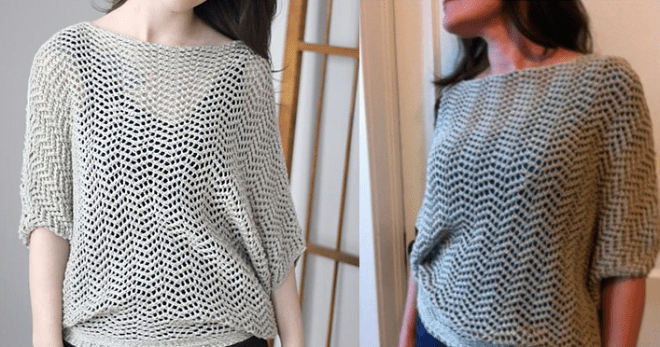
Writer’s Top

This design is intended to have nearly-elbow length sleeves, with a relaxed fit and gentle drape.

I don’t have the absolutely height for the Knitscene model on the right, but what I hope you can see is the difference in a couple of lengths between the model and I.

Look at the sleeve length on me (on the left): they are just a tiny bit longer than designed for. The consequence is that they have a very small wrinkle above my elbow from where I’ve moved my arms. On the model, the sleeve length is closer to the intended, designed-for length.

What I think you may also be able to see is the width of the neckline. I personally know that I have sloping shoulders, so you can see the difference in shoulder shape between the model and I.

NOTE: The shape of your shoulders, like many other fine points of fit, is something that certainly effects how clothes look on your body.  My personal experience is that I had no real knowledge of the slope and shape of my shoulders until I started looking more deeply into fit a few years ago. I hope that bringing up this point helps you to realize two things: there’s NOTHING wrong with your shape, and that there may be aspects of your body shape that you have never considered before, but do indeed have an effect on the way clothes look on your body.

What would I do to petite this knit for my body? I would consider shortening the sleeves by about 0.5″ and narrowing the neckline opening. With the side-to-side construction and relaxed fit, this would be relatively easy to do. Narrowing the shoulders, and even adjusting the width of the back to be narrower than the front, would be quite simple math. I would be concerned, however, not to narrow it TOO much, as that would pull the side seams backwards, and that’s not a look I’d want to go for.

lb
Image on right copyright Harper Point Photography / Interweave

Thrysos

A top down yoked blouse, Thrysos demonstrates a fit issue that was raised again and again by participants in the fit survey last month: yoke depth.

I designed this sweater with a lacy yoke. It was intended to be a layering piece, since the top part would be open work (that said, this is yet another area where taste and style are subjective; you can wear anything any way you want!)

The intention of the design was for the lace section to end at the sleeve depth; that is to say, the lace should not extended far down onto the wearer’s chest. The Knit Picks model on the left has a fit demonstrative of what I was designing for. The fit of the design on me (at the right), shows just how low that yoke reaches on a body that has an armhole depth measurement that is shorter than designed for.

In this particular case, I do not like the way the top fits me, and so do not wear it. My evaluation of the fit is that it is poor. This example demonstrates how the designer herself can be designed-out of the fit of a garment because she measures significantly differently than the sizing charts from which she works, even though she knit the design in her size, directly from the pattern.

What I hope you take away from this example is that petite fit and vertical sizing issues are valid concerns that are sometimes more complex than simply “make it shorter”. I also hope you take away an appreciation that while it’s valuable to know the size (usually listed as bust size) of the model and the size she is wearing, it is also valuable to know, or at least consider, that the model you’re looking at may have very different vertical measurements than you do, and to plan and prepare accordingly. We’ll get into those plans in May and June!

What would I do to petite this knit for my body? I’d have to redo what might be relatively complex math1 to shorten the yoke length. This would require a reassessment of 1) the length of yoke I need, 2) row gauge and how that effects the lace repeats, 3) the width of the neckline either through a total math re-do or trying to make it one size smaller,  4) and ensure I end up with the correct circumference at the sleeve separations.

lb
Photo on left copyright Knit Picks

Lady Bat

This pattern is intended to have a very drapey, over-sized fit. The two examples below demonstrate how fit, style, and taste are a moving target and quite subjective! Because the style of this garment is over-sized, it’s pretty easy to argue that the fit is perfectly fine/flattering/awesome on all three individuals, regardless of height.

In the first example below you’ll see the same garment on me and on Holla Knits’ model Kristen (who is around 5’5″). The difference in height is only about 4″.

lb
Photo on left courtesy of Holla Knits

And below is an image of the same pattern in the same size, but knit by a different person. I wrote a post about this comparison way back in 2013.

Looking at these two images, you need to know: the person on the left is 10″ taller than the person on the right. I ask you: could you tell? Did the garment give you any clues to that information? Or did you presume the individuals were of similar height, or had knit totally different sizes?

With such an over-sized fit, that drapey look is achieved for both individuals regardless of height, though to slightly different effect.

What would I do to petite this knit for my body? In this case, I’m pretty happy with the vertical fit and the amount of drape. If I wanted it less drapey, the side-to-side construction would allow me to make it shorter relatively simply. Another consideration about my own body and the CYC chart sizes is my hip circumference. As this isn’t a vertical measurement I won’t go in to it too much here, but that circumference dictates a lot of size decisions in this design and because I have wider hips, the top can’t be pulled down as low as it could on someone whose hip circumference matches, or is smaller than, the sizing chart numbers.

lb
Image on left copyright Michelle of My So-Called Handmade Life

Beach House

I designed this pattern to hit approximately at the waist in the front, and dip down about 2″ in the back. It is also designed with a suggested 3″ of positive ease because I wanted it to be something loose and summery.

In the image below you see the very same garment modeled on people of two different heights: there’s me on the left at 5’1″, and my pal Leah on the right at about 5’9″.

As in the Lady Bat example, the looseness and airiness of the design gives a good degree of leeway in regards to style, fit, and taste – all subjective, of course! You’ll also note that Leah, on the right, is wearing the top over a shirt, whereas I on the left have it over a bathing suit.

All that said, the top very clearly hits me on my body at a much lower point than Leah on her body. My hair is covering it a bit, but I think you can also see that the width across the shoulders on me is a bit wider, dipping down just a touch past the prominent bone on my shoulder.

Let’s assume you like the way this design looks on Leah. And let’s say you saw the image of it on me. Would you believe it was the very same garment? Would you alter your plans for knitting the garment?

What would I do to petite this knit for my body? Personal preference-wise, I’m quite happy with the way this fits me. But, if I wanted to bring this in line with how it would fit the body it’s designed for with the CYC measurements, I would have to consider 1) shortening the body length, which in this case is simple to do, 2) decide just how I would narrow the shoulders. as this knit has no shaping through the body and the mesh on the front would make it a bit bothersome and visible to add in bust short rows upon choosing a smaller size to knit.

lb
Photo on right courtesy of Holla Knits

Geo Delight

I designed this pattern to be a relaxed, open-front piece you could easily throw on over a casual outfit for an extra layer of texture, colour, and warmth. I intended about 5″ of positive ease based on bust circumference.

The image below shows you the same garment on two people of different heights. I’m 5’1″, and the model Laura (at the left) is 5’9″.

To reveal my own bias, I just really have a soft-spot for this design, so I subjectively believe the design fits both wearers.

That said, you can objectively see that the front length and the textured area around the shoulders ends at a different part of the body on each person. Of value to our discussion is the question: would you prefer one fit over the other? Consider the impact the model has upon the formation of your opinion and expectations of a design.

I hope ALL of this helps you feel that there is NOTHING wrong with your body, and that all of this reveals the incredible intricacies we have to navigate in the complex system that is clothing design and creation.

What would I do to petite this knit for my body? Again, I’m pretty happy with the fit as-is, but if I wanted to bring this more in alignment with shoulder widths catered to in the CYC numbers, I would have to consider 1) tactics for narrowing the shoulders which cascade consequences for design elements such as the mesh and the colourwork on the back, 2) shortening the textured top section, which wouldn’t be difficult to achieve, 3) possibly reduce the width of the neckline ribbing, as it rides up my neck and covers the front of my torso more than the body it’s assumed to cover. (Incidentally, I happen to really like the look of how the neckline rides up my neck, but, that’s a point of taste!)

lb
Photo on left courtesy of Holla Knits

Stay Tuned…

I’ll be posting some feedback from a brief interview I had with Kathleen Cheetham, creator of the line of sewing patterns Petite Plus, in the coming weeks. For now, you can “meet” her through this Craftsy class video.

Question

When selecting a sweater pattern to knit for yourself, do you find that you’re attracted by the official pattern photo, or a photo of the design on an individual knitter?

Resources

1 I’ve footnoted this because I want to emphasize that I said relatively complex math. I know there’s loads of you out there laughing at the idea that the division and multiplication involved in this is complex, but I hope you can appreciate that more work and moving parts are involved here than, say, simply removing 1″ of stockinette.

#KnitPetiteProject: Is a valuable change affected in “petiting” a knit? Let’s examine some real life examples.

#KnitPetiteProject: Fit Survey Results

Our last post where we talked about taste and the subjectivity of what’s “flattering”.
The #KnitPetiteProject plan.

All other #KnitPetiteProject posts.

Survey results time!

As a refresher, this is the survey. Only 2 questions, short answer format:

  1. As a petite woman, what fit issues do you encounter in knitwear?
  2. What suggestions do you have for the #KnitPetiteProject?

As of the writing of this post, 85 people participated.  I’ll be keeping the survey up if people are still interested in participating.

Let’s go over the answers; I’ll do a wee recap, and then include all the responses below.

Of all the responses…

64% of people specifically said they have issues with the length of sleeves, yokes, and sleeve caps

46% of people specifically said the shoulders of sweaters are too big for them (there was a total of about 3 people who said shoulders were too narrow for them)

27% of people specifically mentioned bust size as an issue; of this percentage, 33% said it was too big, and 67% said it was too small

26% of people specifically said the necklines are too low/wide

42% of people said there’s issues with the backwaist length

a number of people particularly mentioned issues related to being petite plus, and other expressed concern with proportions of design elements

And there were a bunch of really great ideas for the #KnitPetiteProject that will absolutely influence what we do this year, including:

  • creating a Ravelry group so everyone can share ideas easily
  • tips for approaching pattern adjustments
  • How to compare pattern schematic measurements with actual measurements
  • suggestions for knitters to recognize the fit issues they have and how to correct the pattern for better fit
  • Identify and explain the sweater styles that can most easily be customized for varied body shape
  • Help knowing a good rate of decreases/increases on sweater bodies or sleeves; arithmetic!

What does this show us?

  1. the variety of bodies out there! It’s valuable, grounding, and refreshing to hear so many people are different in so many ways.
  2. people’s knowledge or lack of knowledge regarding diagnosing fit issues. This is a big issue with me; I find it tricky to figure out how some things do or don’t fit and why. Diagnosing fit is the first step to learning the tools and tactics to achieve the fit you want.
  3. we need to spread the word and let people know what the #KnitPetiteProject is all about! There were a few people who weren’t quite sure what we’re up to, but were keen on participating nonetheless. Let’s share this with as many people as possible so when we start talking about diagnosing fit issues next month, we have even more minds interested in helping out, sharing information, and learning together!
  4. there’s space and interest in working together to figure out our petite fit issues – our community is growing, and I think it’s time to launch a space for us to share with each other, pool resources as a group, and possibly, hopefully (!), hold a KAL in the near future! (more on that coming soon!)

And now, the RESULTS!

As a petite woman, what fit issues do you encounter in knitwear?

  • The biggest issue is that “petite” often means “small all over.” I am short but also plus-sized. I have a small bust for my size so petite tops are great for that, but I also like to wear my shirts long, which petite tops are not great for. Petite dresses are the right length but proportionally wrong for me just about everywhere else.
  • Length. Everywhere. Arms, body, often necklines are too low.
  • Proportions are never right. I’m broad shouldered and narrow waisted, so require considerable shaping to get the fit looking right instead of being baggy in places and stretched tight in others.
  • With an ample bosom, shoulders are always too large. The length between the full bust and waist are too long.
  • I’m ridiculously longwaisted, and some patterns think an XL is a size 14
  • Arms too long and wide
  • Sleeves are too long
  • Underarm to waist always needs to be shortened, sleeves are always just a little too long
  • Balancing height vs proportion – shorter in height but still full sized in bust, arm and hip circumference.
  • Sleeve length, placement of decreases with a smaller torsos
  • I am short-waisted, meaning there’s an incj (at most) between my ribs and hip bones. Few patterns help with accommodating that body type. Besides that, petite frames also come with ample busts. I’m a shrimp wearing a 32DD. Shaping in limited space limits knitting options.
  • Neckline too wide Shoulder width too wide Sleeve too long Length to waist too long
  • If I choose a sweater pattern by bust size, the shoulders are too big. I can adjust lengths fairly easily as I knit my sweaters top down.
  • Shoulders/arm holes…always too wide/long
  • Arms are usually way too long. 3/4 length sleeves look like I’ve made a mistake or run out of yarn because they look *almost* normal length. This is fairly easy to fix. At the same time, the body of a jumper is never long enough. Maybe because I’m quite wide? Thats harder to fix. I often knit different parts in different pattern sizes to get the right complete garment.
  • The waist shaping hits me at the wrong spot. I am almost finished with a new bottom-up sweater, and I modified the waist shaping so that I went directly from waist decreases to waist increases. Looking at myself in the mirror, it’s clear that my natural waist, which is my narrowest part, is directly under my rib cage and my body only takes that width very briefly. I think I should probably modify the armscye and sleeve depth as well, but I don’t really understand how to do that throughly. I am lucky to have a B or C cup bust and find that my bust/shoulder range is fairly accurately represented by standard patterns, but it could still be improved.
  • 1. shoulders and sleeves too wide, waist shaping in the wrong place 2. sock patterns are always too big
  • Not small enough in the bust.
  • Sleeve length and waist placement on shaped garmets
  • Everything has to be shortened and I use my upper bust measurement to select a size instead of bust size. That way the shoulders will fin.
  • Width between shoulders!!! So many adjustments to make.
  • Shoulders too wide in pattern is the most difficult to manage; sleeve, skirt and torso length are easier to adjust but all need consideration.
  • I’m petite size 4 bottom but I wear a size med to large top. Only 5 ft 1/2 inch tall!
  • Shoulder and back measurements on non-raglan sweaters don’t work for me. overall length is easy to customize, and there are a lot of tips for bust adjustments, but the yoke/shrug/set in caps on sweaters don’t seem to adjust for height, only width
  • Bust depth too deep. If I lift up the shoulders by about an inch or so the bust shaping is then in the right place. V necks too low. Sleeves too long.
  • I always have fit issues in the shoulders for both knitwear and ready-to-wear.
  • Arms and torso are always needing to be adjusted. Especially any waist shaping.
  • I am 5’3″with a fairly athletic body shape and broad shoulders. My biggest problem is my torso is of average length but my arms and legs are short. I guess technically even though I am short, that does not make me petite. If I fit my shoulders, the sleeves are at my fingertips. To have the sleeves the correct length, I need to go to a child’s pattern. I have found through trial and error, that a top-down, raglan pattern fits me the best because I can try it on and customize it as I knit. I have found a few knit designers whose patterns really fit me well with just sleeve length alterations so when I look for a pattern, I go check there first. I pretty much avoid the trendy designs because I know they won’t fit. I just grab my old raglan pattern and change pattern stitches, add lace or cables, etc, and come up with something that works for me.
  • I’m 5’1″ and VERY BUSTY – a G cup. Have always had to redraft a sewing pattern and frankly have stopped sewing fitted garments because I can’t get it just right. Working on my first cardigan and it’s a top down pattern that is not very fitted and hoping to adjust as I go along.
  • Fitting my large bust and small waist at the same time.
  • Back length; armhole depth; back width; sleeve length
  • Sleeves too long; waist shaping is too low; need to customize all sweater pattern that I knit for myself
  • Since I am some 4’10” tall and 91 pounds (in the same size range as an eleven year old girl, according to an old growth chart) many sweater patterns for adults are too long and wide. On the other hand sweater patterns intended for children are not shaped properly for my figure. Children’s sizes often have no waist or hip shaping, but I need such shaping.
  • armhole too deep, neck too large, sleeves and garments too long, waist shaping in wrong place.
  • I’m very short waisted & always struggle with adapting waist increases/decreases. Also between my petite-ness & my lack of buxom-ness, my V-necks always seem to dip down to my navel.
  • length! body length, sleeve length, armhole depth, waist shaping actually at the waist, and so on.
  • Obviously the length of garments, but more importantly, the shaping of most clothes is in the wrong place (ie waist shaping going in where my hips are starting to go out) and not enough room across the back shoulders. For more complex designs, often the pattern or detailing is too big across a smaller frame, or if the design element “travels” diagonally up and across, i run out of torso before the design element gets to where it’s supposed to be.
  • sleeves too long, body too long – which can generally be dealt with reasonably easily; shoulders too wide, necks too deep or wide or gaping – a bit more of a challenge; too much ease in sleeves and at underarms – can sometimes be simple to fix, sometimes not
  • None – I adjust based on measurements
  • I have avoided sweater knitting due to concerns over correct measurement taking. Fit issues concern mostly neck to waist measurement, sleeve and across shoulder and chest measurement. Other issues consist of proper placement of decreases and correct row adjustments to accommodate my smaller size. Of course then any pattern (color work, for example) must also be adjusted, a further major concern.
  • As a sweater knitter, waist shaping. It’s always in the wrong place. Straps, like on tank tops, are always too long.
  • Proper fit through the shoulders and arms. I have narrow shoulders so the neck line can be an issue too-either too low or shoulders too wide. I also don’t have the bust to support some tunic pieces.
  • I have to do the math for where and over how much length to do shaping, and for overall length of everything. But . . . I’d have to do it most of the time even I wasn’t short, because I rarely “get gauge.”
  • Shoulder depth is often too long, especially as I have a large bust and am usually knitting an XL size. I am 5’3″, but have a short torso and long legs proportionate to my height.
  • neckline too low/big, torso too long, sleeves too long
  • I always have to shorten the sleeves and have learned the hard way thst top down is ALWAYS going to be my best choice for a good fit + length I want
  • Always have trouble with shortening neck to armhole length.
  • sleeves too long, neck opening too large
  • The shoulder width is too wide in comparison to the torso (bust, waist, hip) measurements. This is difficult to modify since with a set in sleeve it will have knock-on effects on the armhole shape and the sleeve head. The waist is usually too low, and the sleeves are too long, but these are easier to modify. In some styles I find the neckline too wide and too low, but again these are relatively simple to modify. I really love it when a pattern contains a very comprehensive schematic so I can tell which bits I am going to have to alter.
  • Fit around the shoulders, sleeve length, and waist placement.
  • short waisted but relatively long arms, large bust
  • Waist length too long.
  • I am not only petite (5’0″) but also slim (30″ bust), so I go through this sequence of events a lot: 1. I discover a gorgeous sweater pattern on Ravelry, and I fall in love. 2. I discover that the pattern only goes down to a size 34″. The finished dimensions chart (if one exists or if you’re allowed to see it before purchasing the pattern) indicate that the size 34″ is 4 inches too long. My excitement plummets into disappointment. 3. I pull out Excel and try to recalculate sizing using a smaller gauge. Maybe I can knit the pattern using a smaller weight of yarn, and this will fix the width problem. Size 30″, here I come. Excitement increases. 4. I browse through all the projects on Ravelry and try to find somebody else who has made this in a size 30″. Nobody has, uh oh. 5. I read more comments and project notes. I realize that the sweater has bust darts, waist darts, hip darts, and darts halfway up one’s nose. How does one shorten darts or move darts up lengthwise on a pattern? Also, I have to shorten the arm holes too. And the arms. And the torso. Ugh, this has now become way too hard to modify. I might as well write a pattern from scratch at this point. Also, I have no idea if it’ll even look good on me anymore. Screw this pattern. 6. I give up and continue browsing patterns. 7. Rinse, repeat from 1-7.
  • Shoulders, neckline usually too big. Sleeves too long. Adjusting armholes and overall length for narrow shoulders and shorter torso while still allowing sufficient room for bust (D cup). I’m not only petite but also older, so bust is lower than it used to be.
  • The sleeves are too narrow at the top and too long
  • Sleeves too long and many designs are just overpowering on a smaller frame.
  • Sleeve length: Figuring out how to shorten sleeves proportionately while staying in pattern.
  • I’m petite but have boobs – 28FF bra size. I need very small chest size garments – say 30″ – to which I can add room for my bust via increases and darts. That’s a lot of increases/added volume in a very short vertical height, only 4″ or so between waist and largest bust circumference. This is quite challenging! Basically very difficult to achieve unless there is a plain panel at the side fronts where I can locate horizontal bust darts, which rules out a lot of patterns. I can’t blame designers but it is a frustration. Armholes are often too deep and sleeves, well, sleeves are always much too long. But I’m resigned to just redoing the arithmetic for the incs/decs.
  • Very few issues – I mainly knit loose fitting sweaters. However when I try to adjust sweaters to fit better they tend to be too small!!
  • There are no actual petite sizes for me in most patterns. I’m 5′. Usually sweaters are too long or not wide enough,bust isn’t right. Sleeves start at the wrist and I don’t know when to shorten them ? My grown daughters are the same height as myself, but much skinnier. Vogue never has petite sizes and those don’t fit well when I make items from that magazine for my daughters. My instructor tries to help, but she only knows so much.
  • The arm length is too long as well as length in skirts and dresses.
  • Waist placement is too low and I have to shorten the pattern by 1 1/2″
  • I do not like the sleeve width circumference to be too large. I do not need knit as many inches usually from underarm to hem.
  • Busts are always too big–there are very few patterns for bust measurements below 36″ and many patterns have a very small size around 31″ then 36″, 38″, 40″, etc., completely skipping smaller sizes between a tiny teen and a larger woman.
  • uhhhh….. all of them. I’m 5’0′ and 103 lb, and even if I make the smallest size in a pattern it is inevitably too big, sleeves are too long, hem hits in a weird place. These days I only knit top-down sweater patterns so I can adjust as I go
  • Sleeves too long, shoulders too wide for the bust measurement I need, neckline too low/long.
  • 1. Having to raise the lowest point of a neckline in scoop or V-neck styles. 2. Reducing vertical spacing between neckline and bustline/armholes.
  • These answers are based on my rather limited experience with knitting sweaters. The fit of the neckline/shoulder is too wide for my narrow shoulders (I am 5′ 1 1/2″, 100 lb.). The length can be an issue as well, not always sure how to shorten if there are increase/decreases involved. (I prefer top to mid hip length)
  • The torso is too long and shoulders too wide
  • I’m a large but short woman. Plus sized garment patterns are entirely too long in the arms, too deep in the arm-scye, and often too wide or low in the neck. I don’t mind the extra length on the body because I like to wear tops that are long, and I can adjust that length very easily. Patterns designed for shorter women usually do not accommodate heavier women. I also have a tiny head, and adult hat patterns are usually too large on me.
  • Picking the right size to knit because my bust is a bit larger, but my frame is still small and my shoulders are narrow. V-necks can be too deep. Sleeves are usually easy to modify, although sometimes decreases can be challenging.
  • Oh, where to begin? Sweater patterns where the only thing altered for different sizes is the width. Before I knew better, I once knit a sweater that had the same size neck opening for every size – it had a 11″ boat neck for the 32″ bust size and the 48″ bust size. Drop sleeved pullovers and cardigans can be very difficult to alter for a shorter sleeve and body length. Sweaters with waist shaping but no indication how many inches up waist shaping begins and ends so as to make appropriate modifications (with a lot of work you can sometimes figure it out, but it is a complete hassle). That’s probably enough for now
  • The difference between smaller sizes is too big/not proportional
  • Sleeves and body are generally too long by the time it fits me in the bust
  • Having to modify the shaping on the body and sleeves; shoulders not being narrow enough for the bust.
  • redesigning sleeves for proper length and decreases. shortening body and re designing shaping
  • Length and where & how to shorten
  • yes
  • How to deal with broad shoulders plus a short waist on sweaters.
  • I usually avoid knitting garments because I’m concerned about putting _so_ much effort into making something that won’t fit. I expect that I’m petite plus, though that’s a shape I’ve never come across in stores.. I’m 4’10” and currently most comfortable in a size 16 pant My top and bottom halves are rather proportional to each other, and over the past few years I’ve become somewhat round around the middle. I also have a fairly large for my height bust (d cup). I don’t know if describing my unusual shape helps, thought I’d add what I can.
  • sweater patterns seem to be pretty okay for me–I think I have an average or longish torso but shortish arms and legs. I tend to knit top-down, trying on as I go. this way I can tweak the fit if necessary. I find myself often lengthening the bodice and shortening the sleeves, but perhaps some of this is more out of personal preference (I prefer 3/4 length sleeves) than out of being petite, I don’t know. I do have problems with off-the-rack clothing from stores though. necklines and shoulders are an issue. what’s currently in style can add to that problem. (dropped shoulders and boxy cuts, augh.)
  • Sleeves always too long
  • Sleeves that are too long (though that’s easy to modify, usually). Torsos that have all the wrong ratios for where the bust, waist, and hips fall and the increases/decrease to get those. Shoulders that are too broad. Necklines that would fall off my shoulders (and shouldn’t). Patterns that go in rows instead of inches/cm. I have to recalculate everything, and heaven help me if my gauge is not the same as my swatch. It really discourages me from knitting sweaters, knowing I have to re-do all the pattern stitch/row counts. I’ve had to learn a lot about garment construction and fit to understand how to change those counts, too. (Which was fun to learn! But it’s not fun to slog through a sweater’s worth of calculations.) Cowls and scarves and hats sometimes have problems with length/width, but those are generally easy to modify.
  • overall length of garments, placement of shaping (I have a short torso and there’s hardly any space between the underbust and my waist), design elements in the wrong place, just because I’m short doesn’t mean I don’t have a large bust or carry weight in the belly and upper arms. It’s frustrating (mostly with commercial clothing) when designers think that petite means everything’s small/skinny.

What suggestions do you have for the #KnitPetiteProject?

  • Stay awesome? I have no idea. You’ve been doing a great job so far!
  • Keep up the good work! We short gals need equal time! 😆
  • Remember that petite refers to height, not weight. Plus sized petite patterns are almost non-existent.
  • At 5’4″, I’m on the edge of the petite sizing as regards to my height, so it’s all about the shaping for me. This is easy to adjust for plain stocking stitch knits, but very difficult if it involves lace or cable patterns.
  • Help people find what they need to personalize to THEIR body type.
  • Not sure
  • Perhaps some sort of easy access chart that shows a ballpark reduction in the measurements given in a pattern. I have one bookmarked on my computer that I refer to when dressmaking – http://www.madalynne.com/patternmaking-how-to-make-a-pattern-petite – BUT there is no substitute for (a) knowing one’s measurements; and (b) trying on as you knit
  • I hope the project will create size/grading guidelines for pattern designers.
  • The only thing that has worked for me is looking a store made sweaters and compared the WIP to it.
  • Neckline and shoulder width are my biggest problems, especially with raglan and top-down designs.
  • Patterns should come in petite sizes i.e. for persons with small shoulders and larger chests as this body type does not conform to standard sizing. Shaping should be stated as eg. 1′ before the waist start decreasing rather than as a standard length.
  • Sweater pattern w/sizes for larger bust.
  • I don’t think there is an easy answer because there is no one set of measurements for short people any more than there is for people of any size. There is no average.
  • None so far! This is really interesting stuff and I appreciate your synthesis of all the factors that go into this complex topic. I look forward to the new installments.
  • seems to me that petite fit issues are the same as any fit issues…no two people are alike and very few are standard sizes…something that fits me at 5’0″ and 150 lbs will not fit someone who is 5’0″ and 100 lbs…nor will it fit someone who is 5’4″ and 150 lbs…
  • Make sizes that fall in between child’s size and the usual women’s small.
  • Measure as many petite women as possible and that should help provide new guidelines
  • Be sure to cover those of us who are not shortwaisted. I am narrower between the shoulders, but my petiteness (hee is that a word) comes in my lower leg length.
  • Some designers include an ‘adjust here’ notation – more extensive use would be great. More comprehensive schematics too – many patterns don’t even bother other than ‘Size 10’ or ‘M’ but even those that do usually only have bust measurement and maybe sleeve or torso length.
  • Knitting a dress? Almost impossible.
  • Patterns that suggest not just length in numbers but in body position would be great (i.e., knit the sleeve to elbow, or knit back to bottom of shoulder blade)
  • A whole garment approach rather than just chopping off the bottom inch or so. Eg with sleeves I hardly ever reach the point where all the increases are made before I need to cast off for the armhole edge. Result? Never wide enough above the elbow without amending the rate of increases at the start of knitting a sleeve.
  • Use smaller models when designing for us. A 5’9″ or taller model doesn’t give us a usable pattern
  • I think this is a wonderful project and don’t quite know what to suggest. I know there are lots of short/vertically challenged women. Many have given up knitting garments and just do socks, shawls and stuff for kids and grandkids.
  • Petite doesn’t necessarily equal size 0-2 in Ready to Wear. there are 12-14s out here who are also short/petite and I would guess we need more help adjusting patterns for our petite stature than our tiny friends.
  • I’m not clear on what exactly you are. Are you going to teach fitting techniques, or are you trying to get designers to change the way they fit patterns?
  • Ideas for how to make adjustments in specific areas. How to compare pattern schematic measurements with actual measurements.
  • Sizing options for petite folks
  • Along with offering patterns for petite wearers, or examples of how published patterns would be adjusted, suggestions for knitters to recognize the fit issues they have and how to correct the pattern for better fit. For example, some knitters need to adjust for a full bosom, in addition to being petite, so they need that adjustment as well as the “shorter” lengths for petite.
  • no suggestions, just thanks for starting this!
  • Anything with a waistline detail that flatters and falls in the right place
  • looks good so far
  • How to tweak shaping, and how to tweak design elements to account for a shorter body length.
  • I’m not a pattern designer so maybe this would be very cumbersome, but some notes about how to adjust some petite fit issues in the pattern such as percentages of stitches to remove and where to make those changes. In the case of necks too deep, how many rows to add or what to change in gaping necks. It’s not quite like sewing where you fold the pattern tissue – what would the equivalent be in knitting?
  • None
  • Is it possible to include some “sample” projects to try out any new skills the Petite Project may address?
  • Take the time to research patterns for your petite frame, pay particulate attention to those that have photos and are being worn by a person with your body type. I am very small in the shoulders and bust and have short arms. I’ve learned what to look for in patterns and I accept the fact that there are sweaters I’d love to know, but because of my size they won’t work.
  • I’m not sure what the objective of the project is, other than to help knitters resolve the issues. Giving people tips about how to modify patterns? I’m curious if there are other issues petite knitters have.
  • Awareness!: the craft yarn council measurements do t work fo many many of us!
  • I can’t think of anything
  • non yet
  • Necklines!
  • I would love to know more about how to assess items I have knitted for fit and to determine where the problems are and how to solve them in the future. For a lot of my sweaters I find the shoulder seams slide backwards in wear (pulling the front of the sweater up) and I am having trouble identifying what alterations I should make to solve this.
  • Nothing in particular.
  • Suggestions for adjusting waist shaping
  • Short people come in all shapes. Don’t forget the slim petites; we’re out here.
  • Keep going! This is fascinating.
  • A way to easily resize shaping to modify for shorter torsos and arms
  • How to adjust patterns so that they are not so overwhelming
  • Helping with arithmetic formulas to shorten sleeves in pattern.
  • Encourage designers to be realistic about the limitations of their patterns. It’s OK that not everything will work for me! but please don’t tell me that a 34″ is a small size. No, it’s really not.
  • I’m afraid I have no suggestions – but look forward to the discussions, which might give me some bright ideas!
  • I don’t have any suggestions but thank you for doing this! I have hope for us short people now 🙂
  • To make an app or tool of some kind that you can put in your measurements and it will generate an appropriate version of a pattern.
  • Schematics! They really help me see what the project is intended to be so I can see how I need to change it.
  • I wish all designers would include a schematic in the pattern. Usually beginners may not know they can tweak a pattern to fit their body better. I don’t have any suggestions.
  • I find European and Japanese patterns fit me much better–US designers seem to think that all US petite women are fatter than Europeans or Japanese women, and we’re not!
  • I’m just glad this is a thing, honestly. I’ve been struggling with fit in sweaters since I was 12 and knit my first one.
  • Since I don’t know if this is classes or KAL or what, I am not sure what to suggest. Maybe list good fitting tutorials?
  • Need more aran and cable designs that look good with a smaller chest area.
  • Just recently came across your project and am delighted to see petite fit issues addressed. I welcome suggestions on how to tailor the fit of a patten. Please continue to share your findings!
  • How to fit knitwear for petites with larger chests
  • Address the needs of the short but stout crowd!
  • Take into account that petite does not always mean small bust. I’m a size 2 but often can’t get things to fit properly on my chest.
  • Identify and explain the sweater styles that can most easily be customized for varied body shapes (despite all the hoo-ha about bigger sizes, there isn’t much good advice for petites) example: if short in the limbs, vs short in the waist, what style would be most complimentary & easy to adjust to fit? Thank you
  • Short does not equal no bust
  • tutorials on calculating descreases, how to find your waist if you still have one
  • Instructions on how to ‘petite’ garment patterns
  • I find that length between shoulders and bust is an issue. Especially in raglans, by the time I get to the number of correct increases, the armpit is 3 inches too long.
  • Help knowing a good rate of decreases/increases on sweater bodies or sleeves (i.e. at what point is it too much too soon and gives it a funny look)?
  • I’ve never delved deeply enough into garment making to really wrap my head around it, so I don’t yet know what I don’t know! I do appreciate your work and look forward to finding out what I can learn.
  • a dedicated Ravelry group could be helpful. I’m not very chatty, but I like to share relevant projects to groups and browse the projects others have shared. this would make it easier for fellow petites to spot others with a similar build and see what patterns and adjustments (if any) they’ve made.
  • It would be great to get a list of sweater patterns that are designed with petite proportions in mind — or a list of those that are particularly easy to modify
#KnitPetiteProject: Fit Survey Results

#KnitPetiteProject: A valuable word on taste and what’s “flattering”

Our last post where we hear from real knitters about petite fit sacrifices.
The #KnitPetiteProject plan.

All other #KnitPetiteProject posts.

Please lend a hand to the #KnitPetiteProject and answer this brief survey! We’ll be sharing the results next week!

Above all, I want the #KnitPetiteProject to be a body-positive tool we can all use to empower ourselves, helping us achieve the ends WE want to achieve.

I thought it was important to touch on taste, and what we may consider “flattering” for this very reason (and, in anticipation of next months’ series of posts where we look in depth at our bodies and determine what our fit issues are.)

This is also a valuable point to raise because taste is individual and fashion changes; its expressed value will change the desired fit of a garment, which certainly pertains to how we judge good fit!

If something is your style and you love it, I believe you should wear it, regardless of whether it supposedly “flatters” your body or doesn’t. Plus, if we are being honest, to flatter almost always means “makes you look thinner”, and that definitely shouldn’t be your prime objective when it comes to getting dressed.1 Anuschka Rees

Taste and What’s Flattering

Many of the top hits you get if you google “petite fit”, “sizing for petite” and the like are lists of “rules” intended to make you look taller (and as usual, enforce/create a look of thinness).

I avoid talk like that because it’s destructive: it takes as its position a presumption that 1) you focus on your flaws 2) they are indeed flaws, and 3) you want to conform to the author’s ideal of beauty. The underlying notion here is body shame. I’ve wasted enough energy in my life being embarrassed by my body. I suspect many of us feel the same.

So when I embarked on research for the KnitPetiteProject, I wanted to avoid garbage like that. I NEVER want to make assumptions about how someone wants to look. I want to have conversations and share information about how we can achieve what we want to achieve, regardless of what the “rules” say we should want to achieve.

An example: (and I use myself here so as to prevent embarrassing anyone else!) I’m quite sure that my taste in clothing, from the shapes, colours, patterns, and styles, is objectionable to many people, for many reasons. Tastes differ, and so do values and morals. If I were to entirely follow presumptions of how I should try to look, I certainly wouldn’t dress the way I do.

I was emotionally abused2 for significant years of my life by cruel peers who instilled in me a disgust for my body. To this day, it’s an internal fight to wear what I want to because my “fat might be hanging out” or some such garbage. Those peers hated fat. They hated it so much that they expended incredible amounts of energy making me feel like a disgusting excuse of a person.

So that narrative is there, in my head, whenever I choose to wear my beloved crop tops. That narrative is there, but I feel like I’m smashing smashing smashing it each time I wear those tops that are so cute! Those tops that I made! With beautiful bright colours, and lovely yarn, and all that brings me joy!

All that is to say, if I allowed that narrative to win, I wouldn’t dress as I do. My tactics each morning would be about hiding and disguising, not celebrating and enjoying. That narrative is the dominant narrative of our culture here in the modern Western world.3 I’m not a “perfect” shape. I have stretch marks and cellulite and rolls, I’m 34, I “shouldn’t” be wearing short shorts and crop tops and all other manner of items and colours and shapes that I do. To all that I say, I’m a grown woman, and I make my own choices about what brings me joy and ultimately, what makes me feel comfortable and confident.

But what if I DO want to look taller/thinner/curvier?

There certainly are people who’ve noted their concerns surrounding “flattering proportions” in the KnitPetiteProject surveys, and designs that may “overwhelm” a petite body. This is a valuable conversation to have! I think, though, that any time we talk about ideas like this it should be without presumptions of “correction”, and instead should be that we are simply very clear about the look we want to achieve, and the tactics we can use to achieve it.

A good resource is Amy Herzog’s Knit to Flatter book and class. When I first enrolled for Knit to Flatter, I did so with a bit of trepidation. I was afraid it might be yet another “if you’re pear shaped, you have to dress like THIS!!” Fortunately, it is not like that! Herzog does indeed talk in depth about aesthetics and proportion in relation to body shapes, giving advice like colourful yoked sweaters “balancing” out a body that is wider at the bottom. But from the outset she makes herself very clear by stating that we should all dress in whatever way makes us feel good.

The line of distinction that I want to make clear is this: yes, there are tactics you can utilize to add or remove emphasis, but I will NOT EVER assume you would want to employ a particular tactic because you are a particular shape.

Interested in a more in-depth discussion of this topic? See the Question of the Week below!

Changing Fashion and Flattering Fit

“…perception of good fit varies from person to person as well as within the same individual over time and depending on environmental context.”4

Changing fashion plays a role in our perceptions of good fit. To get the look of an oversized 80s sweater, you’ll be judging its fit based on different rules of measurement than, say, a fitted 50s-style sweater.

The excellent chapter “Sizing and clothing aesthetics”5 is filled with excellent, thought-proving statements that add more complexity:

“Through taste, individuals are able to demonstrate their interpretation of the cultural moment.” (pg 311)

“The subjectivity of taste is complex; understanding the fit of garments as a consequence of taste is more so.”

“In regard to garment size (especially in extreme body types), good and bad fit, like cut, are somewhat elusive. Significantly, it is my assertion that absolute expressions of fit do not exist. If fit can only be accessed as an approximation, then, when fashion changes from tight fitting to loose fitting, the concept of fit is further displaced.” (pg 313)

In light of our focus on petite women, largeness and littleness and its relation to the body, clothing, and fashion, are valuable to reflect on:

“…littleness is implied in femininity and bigness is implied in masculinity. These polarities exist at the basis of fit. In the body’s attempts to characterize itself towards one of another pole, males and females idealize themselves in a segmented section of their continuum… Gender is of course an ambiguous concept.” (pg 318)

All these quotes are shared here with the intention for us all to ponder, for ourselves, what we judge as good fit. What we determine is our own taste and preferences. And this entire post is here to encourage you to feel strong, comfortable, and certain of the choices you want to make about how you look, because next month we’re going to start digging into shape, fit, and the tactics to make clothes fit our petite bodies the way we want them to!

Fun Fact

More a Fun Quote than a Fun Fact…
That chapter in the Sizing book I’ve been referring to in this post is filled with interesting quotes. Here’s another:

“The Elizabethan corset and other forms of structured suppression and figure-molding garments have been influencing the shape and therefore the fit of garments on a women’s body up to and until the 1960s when fashion’s leadership became less dictatorial and more democratic.” (pg 313)

Question

I have a background in art and art history. I am very studied at looking a visual information and human expression through art & fashion, that includes how we take in visual information, ways to draw or repel attention, to enhance or reduce.

I would be happy to have a discussion of this sort here, for the purposes of the KnitPetiteProject. I would stipulate that, of course, this would NOT be prescriptive but instead should illuminate how to draw or repel attention. I would not presume certain shapes desire certain shared ends.

Ultimately: would you like to have a body-positive discussion about aesthetics and clothing? Share your thoughts by commenting on this post.

Resources

1 Anuschka Rees. “The Curated Closet: A Simple System for Discovering Your Personal Style and Building Your Dream Wardrobe“. Ten Speed Press, 2016.

2 This is very much a side note, but I think we should call “mean girls” and the “bullying” they do what it really is: emotional abuse.

3 The modern Western world is a culture I feel comfortable speaking about, but if you live elsewhere, the statement here may certainly be the case for you as well.

4 D.H. Branson and J. Nam, “Materials and Sizing”, Sizing in clothing: developing effective sizing systems for ready-to-wear clothing. S. P. Ashdown, Textile Institute (Manchester, England) Woodhead Publishing in association with The Textile Institute, Apr 20, 2007. pg 266.

5 Van Dyk Lewis, “Sizing and clothing aesthetics”, Sizing in clothing: developing effective sizing systems for ready-to-wear clothing. S. P. Ashdown, Textile Institute (Manchester, England) Woodhead Publishing in association with The Textile Institute, Apr 20, 2007. pgs 309 – 327.

#KnitPetiteProject: A valuable word on taste and what’s “flattering”

#KnitPetiteProject: What fit sacrifices does a petite person make when wearing a non-petite sized garment? Hearing from REAL knitters!

Our last post examining the value in a difference between regular and petite sizing.
The #KnitPetiteProject plan.

All other #KnitPetiteProject posts.

Please lend a hand to the #KnitPetiteProject and answer this brief survey!

So far in the #KnitPetiteProject our sources have been from fibre science and garment design scholars, knitting experts, and some internet sleuthing for information shared by apparel manufacturers and retailers.

This week, we’ll turn to the actual, lived experience of real knitters.

The question we’re looking at in this post is: if a petite person does not modify their knitting to accommodate their shorter vertical lengths, what are the repercussions?

The following are comments shared from the first #KnitPetiteProject survey (information collected anonymously) and shared in a forum on Ravelry (posters kept anonymous):

Waist and Bust Shaping and Torso Lengths

  • Waist shaping is always an issue, since my torso is not super long and never seems to align with where shaping starts/ends in a pattern. I have tried to do the math with my measurements and gauge and the schematic. Disaster.
  • The waistline of fitted clothing always hits me in the wrong place (it’s too low).
  • I wonder about modifying for my petite, large-breasted, but not fat-bellied body. If I select a pattern for my bust size, it’s often too big in the waist and shoulders.
  • At just under 5’ tall, I have had the tunics that ended up as dresses, and sleeves best suited to an orang-utan.
  • I’m 5 feet tall, but I’m busty, which makes everything difficult. If I find something that fits my measurements around my bust, I wind up cutting six inches off to make it short enough.
  • I have to stay away from large-scale cable or diamond-shaped aran patterns because my tweaking for less stitches around the bust would usually alter the appearance relative to my adjusted neckline and armholes.

Shoulders, Back and Arms

  • I often have to adjust armhole depths, overall length, and inc/dec frequency.
  • When I knit patterns based on my bust size, the rest of the sweater is too big. How do I modify the pattern so the body of the sweater fits properly?
  • I have short arms and am narrow through the shoulders but a regular bust size and distance across the back. Neck and shoulder fitting and shortening sleeves are sometimes difficult.
  • I avoid raglan styles due to difficulty in shortening pattern proportionally
  • How to modify garments to fit my narrow shoulders without being too tight in the sleeves and on the rest of my L/XL torso.

Proportion

  • The other thing I’m currently thinking about is proportion. Short and average sized means wearing a sweater with yoke patterning that comes down onto the upper arms just makes me look shorter and wider. Not flattering! So what kinds of designs would give me a longer, leaner line?
  • I need to modify knitting patterns for size and style. I love fisherman knit patterns, but the cables and other details can overwhelm me at 5′ and 110 lbs.

Petite Plus

  • I’m petite and full figured, and I feel that I need to resize the length of sleeves but not the length of the body, what gives?
  • I’ll be the lone voice in the wilderness calling for petite plus sizes. I don’t sew, but I do knit. I have no idea how to adapt patterns.
  • …I am mightly irritated by the standard assumption that as we grow bigger in the bust, we will need huge sleeves, wide necklines, and an armhole depth of 10” or more. Or that as we grow wider, we grow taller! …

The Second #KnitPetiteProject Survey!

In February and March we’ve laid a foundation for WHY we may encounter petite fit issues. This month were looking in depth at what those petite fit issues are. I’m asking for YOUR HELP, and sharing the results of the survey at the end of April.

Please lend a hand to the #KnitPetiteProject and answer this brief survey!

Fun Fact

This post was inspired by a book resource recommended to the #KnitPetiteProject, Fit for Real People. We’ll be looking more in depth at this book in the coming weeks. It’s pretty easy to get online via sellers like Amazon if you’re interested in reading along! This is a fantastic example of how all of us working together and sharing information is building a resource we can all use to help us fit our knits to our own bodies!

Question

Have you ever been measured by an expert (ie: seamstress, bra-fitting, any tailoring, etc…)?

Resources
#KnitPetiteProject: What fit sacrifices does a petite person make when wearing a non-petite sized garment? Hearing from REAL knitters!

#KnitPetiteProject: Is there a significant and valuable difference between regular and petite when it comes to knitwear?

Our last post looking at a few different sizing charts.
The #KnitPetiteProject plan.

All other #KnitPetiteProject posts.

In February, we looked at who petite women are. In March, we studied some sizing standards history. And now in April, we’ll be asking a valuable question: is there even a point in considering petite fit in knitwear? Should we even care?

“…height should not increase with size.”1

Right off the bat, let’s clarify a couple of things.

I know I’ve personally been a bit tripped up by the concept of a “sizing standard”, and the concept of individual “sizing systems”. For this week’s post in particular, it’s going to be important to underline the fact that there is NO compulsory sizing standard that clothing designers or manufacturers must adhere to.

Instead, there are complex and in some cases very specifically targeted sizing systems that are developed by any number of industry groups, specific manufacturers, and even individual creators.

For the purposes of this post, we’re going to use the CYC standards (which are widely used by knitwear designers) and ASTM’s Petite Misses’ Body Measurement chart, also touching on Kathleen Cheetham’s Petite Plus chart.

I regret to say that I simply have not found an in depth petite body measurements chart for sizes above a 46″ bust. Please let me know of any resources that fit this description!

As always when looking at charts, I do not want you to feel you are measuring your worth with these numbers! These are just body measurements; averaged out, flawed, and attempting to create a system wherein individuals can be served through the smallest number of different sizes despite the enormous number of ways our bodies differ from each other.

The purpose of this post is to give you an idea as to how shorter vertical (and some horizontal) body measurements can impact the fit of your knitted garments.

What is regular?

We looked a bit at CYC’s body measurement chart last week, and even talked a bit about some weaknesses this chart includes. Nevertheless, it is widely applied by knitwear designers for a number of reasons, including its size range, number of body measurements, and the fact that it’s freely available.

Please keep in mind that not all designers use CYC!

cyc
CYC Body Measurements chart
  • To note: bust size range goes from 28″ – 62″
  • Vertical measurements included are Back Waist Length, Sleeve Length to Underarm, Armhole depth
  • Cross Back measurement is important to determining shoulder sizing and body frame, which is important to selecting size and achieving good fit.

What is petite?

We’ve talked a bit about ASTM in the past, but to recap: this source is worth using in our post today because they are a leading source of body measurement data. They base their numbers on a variety of sources (both old and new), and revisit their charts through specialized committees every few years. That said, it is limited in that it does not include a wide range of larger sizes, and has been shown to skew towards individuals who are more “top petite” than bottom petite.

I can’t say that is is an exact complement, usage-wise, to CYC within the knitwear design community. Generally, as we’ve seen, knitwear design hasn’t focused on petite sizing and the chart very frequently relied upon is CYC (as seen above) and is without petite sizing.

The ASTM Petite Misses’ Chart is not freely available online, so I can’t post all its measurements here.

But what I can do is share a bit about what they have to say about these body measurements, and give a comparison for a select number of measurements for 3 different sizes.

In the standard table, ASTM states that although the information included are body measurements, “… they can be used as a baseline in designing apparel for Misses’ Petite in this size range when considering such factors as fabric type, ease for body movement, styling, and fit.”

chartastmpetite

I’ve selected the sizes listed here because they are the closest comparisons to what exists with CYC.

And since ASTM’s petite charts do not include bust sizes above 46″, let’s also take a peek at Kathleen Cheetham’s chart:

petiteplus

On Cheetham’s chart, note that:

  • the bust range is from 38″ – 50″. This is still not a direct comparison to the size range in CYC, which extends up to 62″
  • she also has Back Shoulder Width and Center Back Waist Length, which we can now compare against our regular measurements from CYC.
  • her charts are very specialized to the petite plus body size, with narrow shoulders, D-cup bust, and a tummy.

Where do the differences lay?

Cross-reference time!

The number of measurements all these charts share is limited, but I’ll pick a few here to demonstrate the point.

There are certainly other numbers that would be helpful in demonstrating the value and significance of the petite/regular difference, but as we are limited by the charts and their copyright availability, I’ll limit our discussion to just three examples.

All three of these numbers are significant to good fit. As we’ve learned earlier this year, fitting your frame is important, and determining the size of your frame rests on accurate shoulder measurements and fit. (Also important to this is a high chest / upper bust measurement, but as this isn’t a shared number through all three of our charts here, I’ll have to omit it from our analysis today).

Cross Back

The smallest sizes seem to agree here, with 14″ as the cross back measurement.  But if you take a look at our mid-range size of 36″ bust, we see that the petite body numbers say 15″, where the regular body numbers say 16″ – 16.5″.  The 46″ bust size give a petite number of 16″ 5/8, versus the regular number of 17.5″. And from Cheetham’s chart, which is designed specifically for petite plus women with narrow shoulders, the difference is even starker: the 50″ bust on her chart is 15″ 3/4, whereas the regular chart says 18″.

Center Back Waist Length

The smallest size in petite 15″ 3/8, versus 16.5″ in the regular chart. A mid-range size of 36″ bust gives a petite number of 15″ 3/8, versus 17″ 1/4 in the regular chart. And the largest size we can compare, a 50″ bust, measures 14″ 7/8 on Cheetham’s chart versus 18″ on the CYC.

You’ll start to notice that Cheetham’s chart is not a total complement to the ASTM numbers. Through this disparity we can see the plurality of sizing systems; Cheetham’s chart is for a highly targeted market of petite plus sized women. I’ve contacted Cheetham for an interview. I hope to be able to share more info with you on how she created her charts when she responds.

Armhole Depth

The smallest sizes in petite gives this number as 5.5″ versus 6.5″ in the regular chart. Our medium range size of 36″ bust gives a petite armhole depth of 5″ 7/8, versus a regular armhole depth of 7.5″. And our largest comparable size, the 46″ bust, gives a petite number of 6″ 5/8 versus 8.5″.

How does this affect hand knits?

Next week we’ll hear feedback from REAL knitters on the fit sacrifices they make when dealing with regular sizing for their petite bodies. For today, let’s touch on the topic of the importance and value of petite body measurements and regular sized hand knit patterns.

Cross Back, Back Waist, Armhole Depth: Why do these discrepancies matter?

The cross back number plays a role in where your shoulder seams are going to lay (for set-in sleeved sweaters), and determine the amount of room built into anything that’s going around/across that part of the body. For example, I’ve used the cross back measurement to determine how far apart arm openings have to be in items like simple shrugs. If I as a designer have calculated an extra 1.5″ into that number, you’ll have droopy sleeves and/or ripples of too much fabric across your back. This could ruin the look of a garment.

The centre back waist measurement is important to fit because it determines the length of your sweater from shoulders to waist. As knitters, you know that some sweaters require significant waist shaping. This is functional, but can also be an important, decorative element of the sweater. If that waist shaping is happening even 1.5″ away from your actual waist, it will sit oddly on your body and you may have too much fabric in some areas, and then too little in others. You could get folds of fabric at the small of your back and weird-looking bunching. This also cascades length issues above and below the waist point.

Armholes that are big and a bit saggy might indeed be your stylistic choice, but if you want to achieve the designer’s intended look for the garment, then this measurement deserves attention.

Stretch

Materials are one of the critical factors that affect garment fit, and therefore an understanding of material properties has an important place in the development of garment sizing.2

There are certainly some stitches, gauges, and other factors that will tighten up hand-knitted fabric, but in general many hand knits can be said to have a good degree of stretch.

I’ve personally made much use of this in my own hand knits and designs; this stretch means you can use negative ease and create a garment or accessory that is snug to your skin. As we touched on last week, that is sometimes a matter of taste (tight sweaters that hug your body, think 1940s “sweater girls”), and it is sometimes a matter of function (hats and socks have negative ease so they stay on your body, where they’re meant to be!)

That stretchy quality also makes knitted fabric more “forgiving” for fit, but of course, it does not mean that it erases fit concerns entirely. As D.H. Branson and J. Nam state in their chapter on materials and sizing in “Sizing in Clothing”:

“The fitting process can be simplified in the use of stretch materials as the stretch can potentially compensate for individual body variation that would require greater attention if the design were executed in a woven fabric. Yet, it is erroneous to assume that a stretch fabric garment will automatically fit in all the right places and provide ease of movement.”3

One such way a sewing pattern may pay more attention to fit than a knitting pattern would is the sleeve cap shaping. Sewing patterns may make the slope of the front of the cap a different shape than the slope of the back of the cap. Knitting patterns rarely do this.

Knitting legend Shirley Paden also makes note, “…because woven fabric do not have the stretch of knitted fabrics, they are generally 1″ – 2″ (2.5 to 5 cm) larger than their knitted counterparts. Keep in mind that cable and twist-stitch patterns will make dense, narrow fabrics while openwork and lace patterns will make very stretchy fabrics…Typically, you’ll want to add 1/2″ to 1″ (1.3 to 2.5 cm) of ease to the knitted fabric to attain a similar drape to [a woven counterpart]”.4

Weight of Fabric

Yarn comes in many thicknesses and fibres. These factors exert their inherent properties on fit in a number of ways.

For example, a super bulky knit sweater will not only be heavier than a DK weight sweater, the actual thickness of the yarn will consume part of the body space measurements. This is an aspect that a good designer would certainly take into account.

A heavy weight of yarn thickness or fibre will also exert more physical weight on the garment. This may be compensated for within the design, but there are repercussions if the wearer’s body isn’t the length the design assumes it is. The intended drape of the design may be incorrect, the lengths may drag down. And we may get that dreaded (unintended) super low neckline.

As Maggie Righetti says in her excellent book Sweater Design in Plain English, “Most home-knit fabrics stretch a great deal lengthwise. They do not stretch so much crosswise…Blocking the sweater will NOT stop the lengthwise stretch. No thing yet devised by man stops gravity!”5

If you already have too much vertical length in your knits, and as Righetti assures us, it WILL stretch over time, the length issue is compounded by the weight/stretch of hand knit fabric.

#KnitPetiteProject Wants to Know…

In May, we’re going to start looking at the nitty-gritty of different petite mods for knitwear. The first post of the month is going to give some real-life examples of knits that have been modified for petite bodies.

Want to help out? Please let me know your experience with making petite mods to your knits. What modification did you make? Which pattern did you choose? Are you happy with the results? Contact me by replying to this post, or email me at canaryknitsdesigns at gmail dot com.

Thanks for your help!

The Second #KnitPetiteProject Survey!

In February and March we’ve laid a foundation for WHY we may encounter petite fit issues. This month we’ll be looking in depth at what those petite fit issues are. I’m asking for YOUR HELP, and sharing the results of the survey at the end of April.

Please lend a hand to the #KnitPetiteProject and answer this brief survey!

Fun Facts

“The three vertical measurements from underarm level to waist derived from the anthropometric survey actually decrease for each larger size up to bust circumference of 39 inches (99 cm). For sizes larger than 39 inches, the vertical increases are positive, but very small. None is incremental.”6

“Currently, ‘trial and error’ has been used to modify patterns for knit fabrics and to determine grading rules to create a set of sizes.”7

Question

What petite modifications do you make to your handknits?

Resources

1 N. A. Scholfield, “Pattern Grading”, Sizing in clothing: developing effective sizing systems for ready-to-wear clothing. S. P. Ashdown, Textile Institute (Manchester, England) Woodhead Publishing in association with The Textile Institute, Apr 20, 2007. pg 180.

2 D.H. Branson and J. Nam, “Materials and Sizing”, Sizing in clothing: developing effective sizing systems for ready-to-wear clothing. S. P. Ashdown, Textile Institute (Manchester, England) Woodhead Publishing in association with The Textile Institute, Apr 20, 2007. pg 264.

3 Ibid, pg 269.

4 Shirley Paden. Knitwear Design Workshop: A comprehensive guide to handknits. Interweave Press, 2009. pg 20.

5 Maggie Righetti. Sweater Design in Plain English. St Martin’s Press. 1990. pg 24.

6 N. A. Scholfield, “Pattern Grading”, Sizing in clothing: developing effective sizing systems for ready-to-wear clothing. S. P. Ashdown, Textile Institute (Manchester, England) Woodhead Publishing in association with The Textile Institute, Apr 20, 2007. pg 180.

7 D.H. Branson and J. Nam, “Materials and Sizing”, Sizing in clothing: developing effective sizing systems for ready-to-wear clothing. S. P. Ashdown, Textile Institute (Manchester, England) Woodhead Publishing in association with The Textile Institute, Apr 20, 2007. pg 269.

Save

Save

#KnitPetiteProject: Is there a significant and valuable difference between regular and petite when it comes to knitwear?